

Choosing between an ecommerce development team and freelancers comes down to one question: who will still be accountable for your store a year after launch? A freelancer is often the faster, cheaper route for a contained build. A dedicated team costs more each month, but it carries the architecture, testing, security, and maintenance work a growing UK store needs once revenue depends on it.
The cost of getting this wrong is rising. Online sales made up 28.3% of all retail sales in Great Britain in September 2026, according to the Office for National Statistics. Since April 2025, card industry rules have also required merchants to control every script on their payment pages. This guide compares both models on what most comparisons skip: ownership cost over 24 months, UK legal obligations, and what happens when the person who built your store moves on.
What is the Difference Between a Dedicated Ecommerce Team and a Freelancer?
A freelancer is one independent specialist engaged for a defined piece of work. A dedicated ecommerce development team is a group of engineers who work only on your platform under one supplier’s contract and delivery process. It typically includes a lead developer, front-end and back-end developers, a QA engineer, and a project manager.
| Factor | Freelancer | Dedicated ecommerce team |
|---|---|---|
| Who you contract with | An individual, often through their own limited company | A supplier company accountable for the whole team |
| Skills covered | One or two specialisms | Front end, back end, QA, DevOps and project management |
| Availability | Shared with other clients; holidays or illness pause work | Cover is built in, so work continues when one person is away |
| Where knowledge sits | With one person | Documented and shared across the team |
| Testing | Usually tested by the person who wrote the code | A separate QA role with a defined test process |
| Best suited to | Fixed-scope tasks, theme changes, small integrations | Custom builds, integrations, an ongoing roadmap and maintenance |
| Typical commercial model | Day rate or fixed price | Monthly cost per team member |
| UK obligations on you | You may need to assess IR35 status yourself | Mostly set out in the supplier contract |
When is a Freelancer the Right Choice for an Ecommerce Store?
A freelancer is the right choice when the work is small, well defined, and low risk. Good examples are a Shopify theme refresh, a single app or plugin integration, a campaign landing page, or a short technical audit.
A freelancer tends to work well when:
- The scope fits in a written brief with a clear end point
- The work does not touch checkout, payments, or how customer data is stored
- Someone in-house can review the code and own it afterwards
- A few days of delay would not seriously hurt sales
The risk with freelancers is structural, not a question of skill. Many freelance ecommerce developers are excellent. But one person cannot be the developer, the tester, and the independent reviewer of their own work at the same time. If you are still choosing where to build, our guide to the best ecommerce platforms for UK businesses.
When does a dedicated web development team for ecommerce make more sense?
A dedicated web development team for ecommerce makes more sense once your store becomes a system rather than a website. That usually means custom business logic, several integrations and revenue that drops quickly if the site slows down or breaks.
Common signals include:
- connecting the store to ERP, warehouse, product information (PIM), CRM or third-party logistics systems
- running multi-currency pricing, B2B trade accounts or more than one storefront
- shipping new features every month rather than a one-off build
- preparing for peak trading such as Black Friday and Christmas, which needs load testing
- inheriting undocumented custom code from a developer who is no longer available
A pattern we see often: a store built by one developer works well until stock sync with the warehouse system starts failing at volume, and no one else understands the custom module behind it.
At that point, a custom ecommerce development team gives you more than extra hands. It gives you shared ownership of the code, a release process, and someone accountable for both. If you are weighing how to engage that team, our posts cover IT outsourcing models and practical tips to hire dedicated developers.
What Does a High-performing Ecommerce Store Need From its Developers?
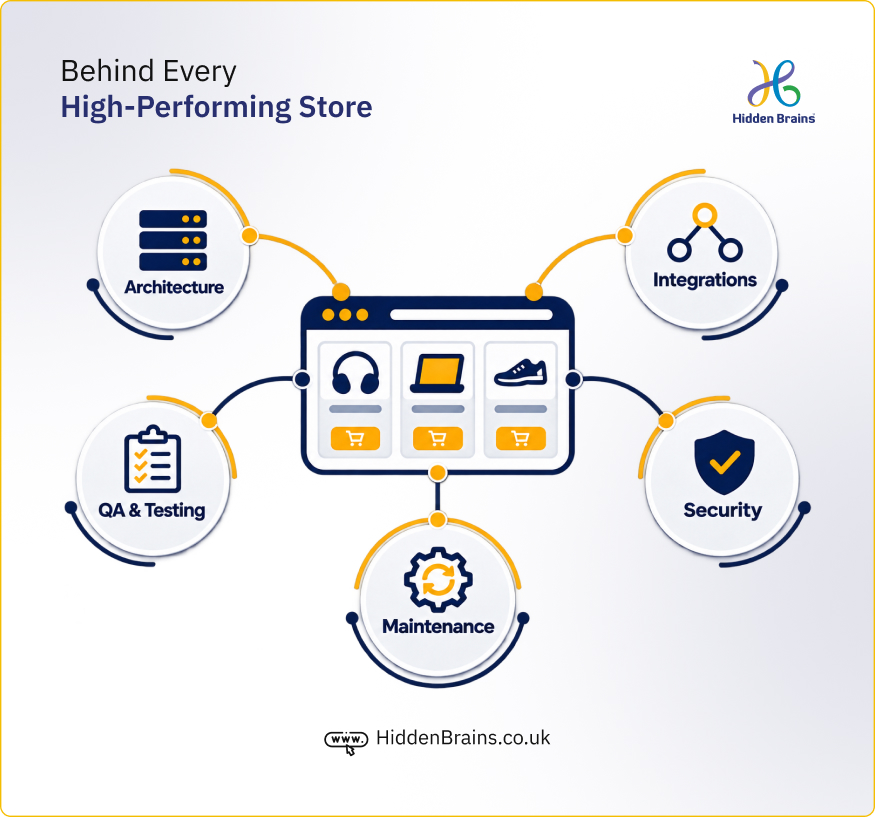
A high-performing store needs four kinds of work beyond the first build: sound architecture, structured QA, security, and long-term maintenance. These are the areas where single-developer setups usually run thin.
The effects show up in sales. Baymard Institute puts average documented cart abandonment at about 70%, based on 50 studies. In its survey of US shoppers, 17% abandoned an order because of website errors or crashes, and 19% because they did not trust the site with their card details. Both are engineering and testing problems as much as design problems.
Architecture that scales
Scalable ecommerce website development depends on decisions that are cheap to make early and expensive to undo. These include caching strategy, whether to go headless, how integrations handle API rate limits, and how catalogue search is indexed. A team with a lead developer reviews these choices before they harden. We cover what happens when they are skipped in the real cost of poor software architecture.
Ecommerce project management and QA
Every release should be regression-tested, with checkout tested first. A separate tester catches problems the author cannot see in their own code. Structured quality assurance services also gives you a record of what was tested before each release.
Secure ecommerce platform architecture
Security covers patching the platform and its extensions, managing third-party dependencies, and controlling who has admin and database access. It is ongoing work, not a launch task.
Long-term ecommerce platform maintenance
Platforms change under you. Security patches, extension updates, and retired API versions all need planned work. Our pre-launch checklist for ecommerce websites lists checks that are worth repeating after every major release, not just at go-live.
How Do UK Rules Change the Freelancer vs Team Decision?
Four sets of rules shift risk onto whoever runs a UK online store: IR35 off-payroll working, UK GDPR processor contracts, PCI DSS v4 payment-page controls and the DMCC Act’s price transparency rules. None of them bans freelancers, but each adds work that someone must own.
IR35 off-payroll working rules
If your business is medium or large, you must decide the employment status of a contractor who works through their own limited company and give them a Status Determination Statement. GOV.UK treats a private-sector client as medium or large if it meets two or more of these: turnover above £10.2 million, a balance sheet total above £5.1 million, or more than 50 employees.
The position is different when you engage a company to provide an outsourced service. GOV.UK says the client does not apply the rules in that case, and the supplier is responsible, but contracts must not be relabelled to avoid them. Take professional advice on your own arrangements; this section is general information, not tax advice.
UK GDPR processor contracts
Any developer or supplier who handles customer data on your behalf is acting as your processor. The Information Commissioner’s Office says a contract is needed every time a controller uses a processor. Sub-processors need their own contract too. In practice, a freelancer with access to your production database needs a data processing agreement, and this is often missing.
PCI DSS v4 payment-page scripts
Since 1 April 2025, PCI DSS requirements 6.4.3 and 11.6.1 have applied to merchants who run their own payment pages or embed payment forms. Every script on a payment page must be authorised, justified and protected against tampering. The page must also be monitored for unauthorised changes, with alerts to the right people (Clover developer documentation). Each new marketing tag means updating that script inventory, so this is ongoing operational work that suits a team with a release process.
DMCC Act price transparency
The Digital Markets, Competition and Consumers Act came into force on 6 April 2025. The Competition and Markets Authority can now fine businesses directly, up to 10% of global turnover. Its price transparency guidance expects unavoidable charges, including mandatory delivery fees, to be shown in the headline price rather than added late at checkout (RPC summary). Changing how prices and delivery fees are displayed is checkout work that needs testing across product types and shipping options.

What Does Each Option Really Cost Over 24 Months?
A freelancer usually costs less per day. But the comparison that matters is the total cost of owning the store over its life: build, testing, maintenance, security, downtime, and handover.
| Cost item | Freelancer | Dedicated team |
|---|---|---|
| Initial build | Day rate × days | Monthly team cost × months |
| QA and regression testing | Often extra, or self-tested | Included in the team |
| Security patching and PCI script monitoring | Ad hoc, billed when the freelancer is available | Scheduled as part of the retainer |
| Holiday and sickness cover | None; work pauses | Built in |
| Handover if the relationship ends | Next developer pays to rediscover the code | Documentation included in scope |
| IR35 administration (medium and large clients) | Status assessment and record keeping | Generally sits with the supplier for an outsourced service |
| Outage response | Depends on one person’s availability | Response times in the contract |
To be fair to freelancers: for a small store on a stable theme with few integrations, the freelancer total will often be lower over 24 months. A team pays for itself when complexity, release frequency, and revenue at risk are high. For build budgets, see how much custom software development costs in the UK.
Which Model Fits Your Store’s Stage?
Match the model to your store’s stage, not to the cheapest quote. Use this framework as a starting point.
Which Model Fits Your Store’s Stage?
Match the model to your store’s stage, not to the cheapest quote. Use this framework as a starting point.
| Store stage | Typical situation | Recommended model |
|---|---|---|
| Launching | Off-the-shelf theme, small catalogue, few integrations | Freelancer or a small fixed-price project |
| Growing | First integrations, monthly releases, rising order volume | Small dedicated team or a hybrid model |
| Scaling | B2B, several storefronts or channels, ERP and warehouse links | Dedicated team with QA and DevOps |
| Re-platforming | Migrating platforms or moving to headless | Dedicated team, starting with a fixed-scope discovery phase |
Can You Combine Freelancers and a Dedicated Team?
Yes, and many growing stores do. A hybrid model works when the dedicated team owns the core platform, meaning checkout, integrations, and customer data, and freelancers take on bounded work such as design assets, content templates, or a one-off app.
The rule that makes it work is single ownership. One team owns the codebase and the release process. Freelance work goes through that team’s code review and QA before it reaches production.

What Expertise Should You Look for in Dedicated Ecommerce Developers?
Look for proven experience on your platform, with integrations like yours, and in the testing and security work that keeps checkout stable. General web development skills are not enough for a store that handles payments and customer data.
| Expertise area | What good looks like | How to check it |
|---|---|---|
| Platform depth | Shipped work on your platform, such as Shopify Plus apps and Liquid themes, Adobe Commerce (Magento 2) modules, WooCommerce, or a headless stack | Ask for live stores on the same platform and the custom work behind them |
| Integrations | Built and maintained links to ERP, PIM, CRM, warehouse or 3PL systems using REST or GraphQL APIs, webhooks and queues | Ask them to walk through how one integration handled failures and retries |
| Performance | Tuned Core Web Vitals, caching, CDN set-up and catalogue search for high-traffic periods | Ask how they prepared a store for a peak trading event |
| Payments and security | Set up payment gateways with Strong Customer Authentication, and managed payment-page scripts under PCI DSS v4 | Ask how they keep a payment-page script inventory up to date |
| QA and test automation | Automated regression tests on checkout, run before every release | Ask to see a test plan or regression suite from a past project |
| DevOps and releases | CI/CD pipelines, staging environments and a tested rollback process | Ask how a bad release was rolled back and how long it took |
| UK compliance awareness | Working knowledge of UK GDPR, DMCC Act price display rules and accessibility standards such as WCAG 2.2 | Ask how these affected a recent checkout or product page change |
A quick test: ask a candidate team to review a page of your current checkout and list what they would change first. Their priorities show more than a CV does.
How Hidden Brains Approaches Ecommerce Development Teams
At Hidden Brains, ecommerce work usually starts before anyone writes code. We first map the store’s integrations, release cadence and compliance obligations, then size the team around them rather than around a standard bundle of roles.
Two credentials matter here because they answer buyer concerns directly. Our ISO/IEC 27001:2022 certification covers how access to systems and customer data is controlled. Our ISO 9001:2015 and CMMI Level 3 processes cover how releases are planned, tested and reviewed, so quality does not depend on one person. We have delivered software for more than 23 years for clients in 107 countries, and our ecommerce work includes the Scosche ecommerce store.
If your store has outgrown a single developer, see how our web application development services in the UK support custom ecommerce builds, integrations and long-term maintenance, or explore our ecommerce website development services.
The Bottom Line
A freelancer buys you a build. A dedicated team buys you continuity. If your store is small and stable, a good freelancer is a sensible choice. If it is becoming the centre of your business, choose the model that will still be accountable when the original developer has moved on.
Table of Contents