
Enterprise-wide digital transformation is accelerating across the UK, driven by AI adoption, cloud migration, evolving cybersecurity regulations and the need for more connected operations. As organisations modernise their technology landscape, enterprise resource planning implementation has become a strategic priority for improving efficiency, visibility and decision-making.
Modern enterprise resource planning systems are no longer limited to finance or administrative functions. They now connect core business operations, integrate enterprise applications and provide the foundation for automation, analytics and AI-driven insights.
With the UK AI market exceeding £72 billion in 2024 and projected to approach £1 trillion by 2035, businesses are increasingly investing in intelligent enterprise platforms that improve productivity and support long-term growth. However, successful ERP transformation requires more than selecting the right platform. It demands careful planning, process alignment, security and a clear implementation roadmap that delivers measurable business value.
Building the Right ERP Strategy Before Implementation
A successful ERP programme begins long before software configuration or vendor selection. The organisations that achieve the greatest value from ERP investments are those that first establish a clear transformation strategy.
ERP should not be treated as an isolated IT upgrade. It should become a foundation for improving how your organisation operates, collaborates and responds to market changes. Across Europe, this strategic approach is becoming increasingly important.
Across the UK, organisations are accelerating digital transformation to improve operational resilience and competitiveness. As AI, cloud computing and automation become mainstream, ERP is increasingly viewed as the digital backbone that connects business processes, data and decision-making. This shift makes strategic ERP planning essential rather than optional. Before beginning an enterprise resource planning implementation, consider these critical strategic steps.

Start with a Business Assessment
The first step is understanding where your organisation stands today. A detailed business assessment helps identify operational challenges, technology limitations and opportunities for improvement.
Key areas to review include:
- Existing business processes and workflows
- Current software applications and technology infrastructure
- Data quality and reporting capabilities
- Operational bottlenecks
- Compliance requirements
- Department-specific challenges
- Future growth plans
For example, a manufacturing company may struggle with disconnected production data, inventory inaccuracies and delayed reporting. A logistics organisation may face challenges around supply chain visibility and warehouse coordination.
Understanding these pain points ensures that ERP objectives are connected to real business needs rather than technology trends.
Map Current Processes Before Automating Them
One of the most common ERP implementation mistakes is automating inefficient processes. Before introducing a new system, organisations should document how different functions currently operate.
Process mapping should cover:
- How information flows between departments
- Where manual approvals slow operations
- Which tasks rely on spreadsheets or disconnected tools
- Where duplicate data entry occurs
- Which processes require standardisation
This exercise helps you identify opportunities where ERP can create measurable improvements. For instance, integrating procurement, inventory and finance processes can help organisations improve purchasing decisions, reduce delays and gain better control over spending.
Conduct a Comprehensive Gap Analysis
A gap analysis helps compare your current capabilities with your desired future operating model. It provides clarity on:
- Required ERP capabilities
- Existing technology limitations
- Missing integrations
- Data migration challenges
- Customisation requirements
- Security improvements
A well-executed gap analysis also prevents unnecessary customisation. Many enterprises customise ERP platforms heavily to replicate outdated processes instead of redesigning workflows around modern business requirements.
The goal should be to use ERP as an opportunity to simplify operations, not recreate existing inefficiencies digitally.
Create a Long-term Technology Roadmap
ERP decisions should align with your broader digital transformation strategy. A technology roadmap defines how ERP will interact with other enterprise business solutions, including:
- Cloud infrastructure
- Artificial intelligence platforms
- Business intelligence tools
- Customer experience systems
- IoT platforms
- Cybersecurity frameworks
This becomes even more important as UK organisations increase investments in AI, cloud services and intelligent automation. With the UK AI market valued at more than £72 billion in 2024 and forecast to approach £1 trillion by 2035, businesses are increasingly building connected digital ecosystems where ERP acts as the central platform linking enterprise applications, data and business operations.
Modern ERP strategies must therefore support a connected technology ecosystem rather than operate as a standalone business application.
Evaluate ERP Vendors Strategically
Selecting an ERP vendor requires evaluating more than software features. Your ERP consulting approach should consider:
Industry Experience
Different industries have different operational requirements. A manufacturing enterprise may prioritise production planning and supply chain capabilities, while healthcare organisations may focus more heavily on compliance, data security and workflow management.
Integration Capabilities
Modern enterprises rarely operate on a single platform. The selected ERP solution should integrate effectively with existing CRM systems, HR platforms, warehouse management solutions, and analytics tools.
Security and Compliance
European organisations must consider regulations such as GDPR and emerging cybersecurity frameworks like NIS2 when evaluating technology providers.
Future Innovation
ERP platforms should support future capabilities such as:
- AI-powered automation
- Predictive analytics
- Intelligent reporting
- Low-code extensions
- Industry-specific cloud capabilities
Working with an experienced enterprise resource planning consulting partner can help organisations evaluate these factors objectively and develop a realistic implementation strategy.
Define ROI Expectations Early
ERP success should be measured through business outcomes, not only technical deployment.
Before implementation begins, define measurable objectives such as:
- Reducing manual processes
- Improving reporting speed
- Increasing inventory accuracy
- Reducing operational costs
- Improving customer experience
- Strengthening compliance controls
- Increasing employee productivity
A clear ROI framework creates accountability and helps leadership teams evaluate whether the ERP investment is delivering meaningful business value.
Also Read: The real Cost of Poor Software Architecture And How to Avoid It
ERP System Implementation Roadmap
A successful ERP system implementation is not a single project milestone but a structured business transformation programme.
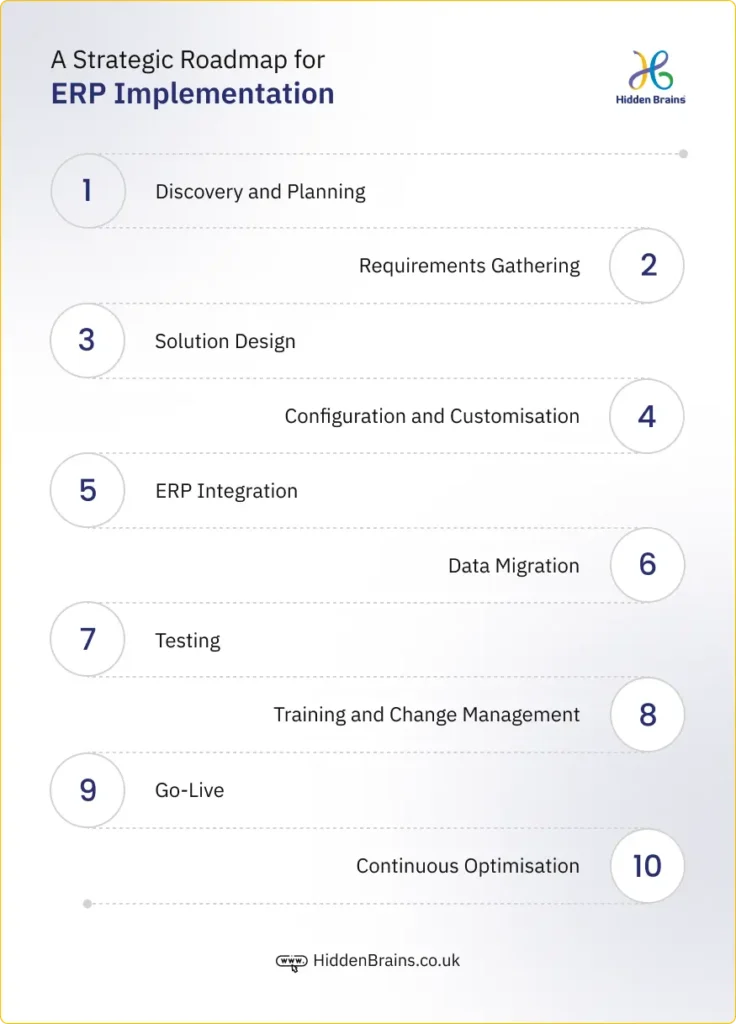
Each phase builds on the previous one to minimise risk, improve user adoption and maximise long-term value from your enterprise resource planning implementation.
Phase 1: Discovery and Planning
Define the business vision, project scope, success metrics, governance structure, budget, and implementation timeline. Early alignment between business and IT teams sets the direction for the entire programme.
Phase 2: Requirements Gathering
Capture functional, technical, and compliance requirements by engaging stakeholders across departments. It ensures the ERP solution supports real business processes rather than assumptions.
Phase 3: Solution Design
Design the future-state architecture, workflows, data models, user roles and system configurations. Prioritise standard ERP capabilities over unnecessary customisation wherever possible.
Phase 4: Configuration and Customisation
Configure ERP modules, automate workflows and develop essential custom features that address unique business requirements while keeping future upgrades manageable.
Phase 5: ERP Integration
Integrate the ERP platform with existing CRM, HRMS, warehouse management, accounting, payroll, BI, and other enterprise applications using secure APIs to enable seamless data flow.
Phase 6: Data Migration
Cleanse, validate, and migrate master and transactional data from legacy systems. High-quality data is critical to ensuring reliable reporting and operational efficiency from day one.
Phase 7: Testing
Conduct functional, integration, security, and user acceptance testing (UAT) to verify system performance, data accuracy, and business readiness before deployment.
Phase 8: Training and Change Management
Provide role-based training, clear communication and ongoing support to help employees confidently adopt new processes and minimise resistance to change.
Phase 9: Go-live
Deploy the ERP system in a controlled manner, monitor performance closely, and establish a dedicated support team to resolve any operational issues during the transition quickly.
Phase 10: Continuous Optimisation
Regularly review KPIs, gather user feedback, introduce AI-driven automation, optimise workflows and expand ERP capabilities to ensure the platform continues to deliver long-term business value.
Also read: How AI-driven MVP Development Turns New Ideas into Market-ready Products
Measuring ERP Success After Go-live
A successful ERP implementation is measured by the business value it delivers after deployment, not by the go-live date. Establishing clear key performance indicators (KPIs) helps you evaluate whether the system is improving efficiency, supporting strategic objectives and delivering a measurable return on investment.
Key metrics to monitor include:
Process Efficiency: Measure reductions in manual tasks, approval times and process cycle durations.
- Order Fulfilment: Track order accuracy, processing speed and on-time delivery performance.
- Inventory Accuracy: Monitor stock accuracy, inventory turnover and reductions in stockouts or excess inventory.
- System Downtime: Evaluate system availability and incident frequency to ensure operational continuity.
- Employee Productivity: Assess improvements in workflow efficiency, collaboration and user adoption across departments.
- Customer Satisfaction: Measure service quality through customer feedback, response times and retention rates.
- Return on Investment (ROI): Compare operational savings, productivity gains and revenue improvements against the total cost of implementation.
Regular performance reviews enable you to identify optimisation opportunities, address emerging challenges and ensure your ERP platform continues to support evolving business priorities.
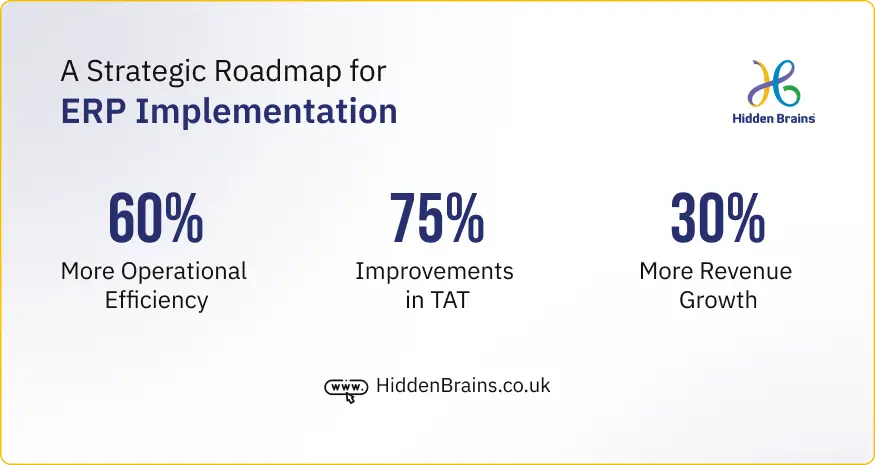
A leading oil & gas enterprise, MRS Holdings modernised its ERP ecosystem and digitised operations across multiple business units. The implementation integrated finance, procurement, warehouse management, HRMS, supply chain, and analytics into a unified enterprise platform, delivering measurable business outcomes: 60% increase in operational efficiency, 40% cost savings, 75% improvement in turnaround time, 30% revenue growth, and 100% terminal automation across five terminals. The transformation also enabled real-time operational visibility, supporting faster and more informed business decisions across the organisation.
Choosing the Right Enterprise Resource Planning Solution
Selecting the right ERP platform is one of the most important decisions in your digital transformation journey. The ideal enterprise resource planning solutions should match your organisation’s operational complexity, industry requirements, security expectations and long-term growth strategy.
Today, enterprises typically evaluate three deployment models:
- Cloud ERP
- Hybrid ERP
- On-premise ERP
Each approach offers different advantages depending on business priorities.
Cloud ERP: Supporting Agile Digital Transformation
Cloud ERP has become the preferred deployment model for many UK organisations because it supports faster innovation, operational flexibility and lower infrastructure overheads. It also enables businesses to adopt emerging technologies more quickly while scaling efficiently as requirements evolve.
A cloud enterprise resource planning platform allows organisations to access ERP capabilities through cloud infrastructure while benefiting from continuous updates and improved scalability.
Key Benefits of Cloud ERP
- Faster implementation compared with traditional deployments
- Lower infrastructure management requirements
- Automatic updates and improvements
- Easier support for distributed teams
- Improved scalability during business expansion
- Access to AI and analytics capabilities
Cloud ERP is particularly suitable for organisations looking to modernise quickly while supporting remote operations and multi-location business models.
As AI adoption accelerates across UK industries, organisations are increasingly choosing cloud ERP platforms that support intelligent automation, predictive analytics and AI-powered decision-making. This enables businesses to modernise operations while remaining agile in a rapidly evolving digital economy.
Hybrid ERP: Balancing Modernisation and Existing Investments
Hybrid ERP combines cloud services with existing on-premises systems. This approach is often preferred by enterprises that need gradual modernisation while maintaining critical legacy applications.
Hybrid ERP can be effective when:
- Existing systems support important operational processes
- Certain data requires specific hosting arrangements
- Migration needs to happen in phases
- Business disruption must be minimised
For large enterprises with complex technology landscapes, hybrid ERP provides a practical transition path towards modernisation.
On-premise ERP: Maintaining Maximum Control
On-premise ERP involves hosting and managing the system within an organisation’s own infrastructure.
Although many businesses are moving towards cloud-based models, on-premise ERP can still be suitable for organisations with:
- Highly customised workflows
- Strict internal infrastructure policies
- Specific operational requirements
- Existing investments in enterprise systems
However, businesses must consider ongoing maintenance responsibilities, upgrade requirements, and infrastructure costs before choosing this approach.
Conclusion
Enterprise resource planning implementation has evolved from a technology upgrade into a strategic enabler of digital transformation. As UK organisations embrace AI, cloud technologies, and increasingly stringent regulatory requirements, ERP provides the foundation for connected operations, data-driven decision-making, and long-term business resilience.
However, technology alone does not guarantee success. A well-defined strategy, careful ERP planning, seamless integration with existing enterprise applications, robust security practices, and continuous optimisation are what transform an ERP investment into measurable business value.
By approaching ERP as an ongoing transformation rather than a one-time deployment, your organisation can build a more agile, efficient, and future-ready enterprise capable of adapting to changing market demands. Do you want to know how? Inquire now!
Frequently Asked Questions
How long does an enterprise resource planning implementation typically take?
The implementation timeline depends on the organisation’s size, business complexity, level of customisation and integration requirements. While mid-sized businesses may complete implementation within several months, large enterprise programmes often take longer due to phased deployments and multi-location rollouts.
Should you choose cloud or on-premise ERP?
The right choice depends on your business objectives, security requirements and existing IT infrastructure. Cloud enterprise resource planning offers greater scalability, faster deployment and continuous innovation, while on-premise ERP may be suitable for organisations with highly specialised operational or regulatory requirements.
What are the biggest challenges during ERP implementation?
Common challenges include unclear business objectives, poor data quality, inadequate change management, excessive customisation, integration complexities and low user adoption. Establishing a structured implementation roadmap helps mitigate these risks.
Why is ERP integration important?
ERP integration enables seamless data exchange between your ERP platform and other enterprise applications such as CRM, HRMS, warehouse management, accounting and business intelligence systems. It eliminates data silos, improves operational visibility and supports informed decision-making.
How can organisations maximise the return on their ERP investment?
Success depends on aligning the ERP strategy with business goals, training users effectively, monitoring performance through KPIs, continuously optimising workflows and adopting emerging capabilities such as AI, automation and predictive analytics to support ongoing business growth.
Table of Contents