



Your product backlog has grown for three quarters running. Hiring a senior developer in the UK takes months. Now someone on the board has asked a fair question: could AI coding agents do the work for a fraction of the cost?
The short answer: for most UK businesses, the choice between AI coding agents vs traditional development teams is a false one. AI coding agents are very fast at well-defined, low-risk work. Traditional development teams are still needed for architecture, judgement and accountability. The businesses getting real value are building hybrid teams, where people stay responsible for the code and agents carry the repetitive load.
This guide looks at what the evidence says, including the UK government’s own trial, along with real costs, UK GDPR accountability, and a task-by-task framework you can use to decide.
What is the difference between AI coding agents and traditional development teams?
An AI coding agent is software that can plan and carry out multi-step coding tasks on its own. It reads a codebase, writes changes across files, runs tests, and opens a pull request for review. A traditional development team is a group of engineers who own the full lifecycle: understanding the business need, designing the system, writing and reviewing code, and answering for it in production.
Two terms often get blurred, so it helps to separate three things:
| # | AI coding assistant | AI coding agent | Traditional development team |
|---|---|---|---|
| How it works | Suggests code as a developer types | Takes a task and works through it with limited supervision | People design, build, test, and maintain the software |
| Typical examples | Autocomplete and chat in the editor | Agent modes that edit files, run commands, and raise pull requests | In-house engineers, a dedicated external team, or a mix |
| Who decides | The developer, line by line | The agent within set limits, then a human reviewer | The team, with business stakeholders |
| Who is accountable | The developer | Still the business and the human who approves the change | The team and its leadership |
The last row matters most. An agent can produce code, but it cannot be accountable for it. That stays with your business, whoever or whatever wrote the lines. As OpenAI’s own guidance for engineering leaders describes, agents now touch planning, testing, review, and deployment. That makes the human oversight question bigger, not smaller.
What AI coding agents in software development actually do well
AI coding agents are strongest on work that is well specified, easy to check, and low in business risk. In those conditions, they cut hours of routine effort to minutes.
The tasks where we see agents earn their keep:
- Test generation. Writing unit tests against existing code, where a failing test is an obvious signal.
- Boilerplate and scaffolding. Data models, API endpoints, forms and configuration that follow a known pattern.
- Contained refactoring. Renaming, upgrading a library version or removing dead code, with a test suite to catch mistakes.
- Documentation. Explaining legacy modules, writing README files and summarising changes.
- First-pass bug fixes. Reproducing and fixing a clearly described defect for a human to review.
What these share is a fast feedback loop. When an agent’s output can be checked quickly by tests or a reviewer, mistakes are cheap. When it can’t, they are expensive.
Where traditional software development teams still lead
Traditional software development teams lead wherever the hard part is deciding what to build and why. Agents can write code to a specification. They cannot tell you the specification is wrong.
In practice, people still carry:
- Architecture. Choosing how systems fit together, how they scale, and what will be expensive to change in two years.
- Domain logic. Turning how your business really works, such as FCA rules for a fintech product or NHS data rules for a health app, into correct behaviour.
- Integration with what you already run. Legacy systems, undocumented APIs, and data that does not match its schema rarely fit a clean prompt.
- Trade-offs with stakeholders. Scope, deadlines and risk are negotiated between people.
- Ownership after launch. Someone has to be on call, explain an incident and fix the root cause.
A useful test: if a mistake in this piece of work would reach a customer, a regulator or your accounts before anyone noticed, it needs an engineer who owns it.
What the evidence says about AI-assisted software development
The evidence shows real time savings on individual tasks, alongside heavy review effort, mixed results for experienced engineers and a persistent security gap. All of these hold at once.
The UK government trial: time saved, but most suggestions not accepted
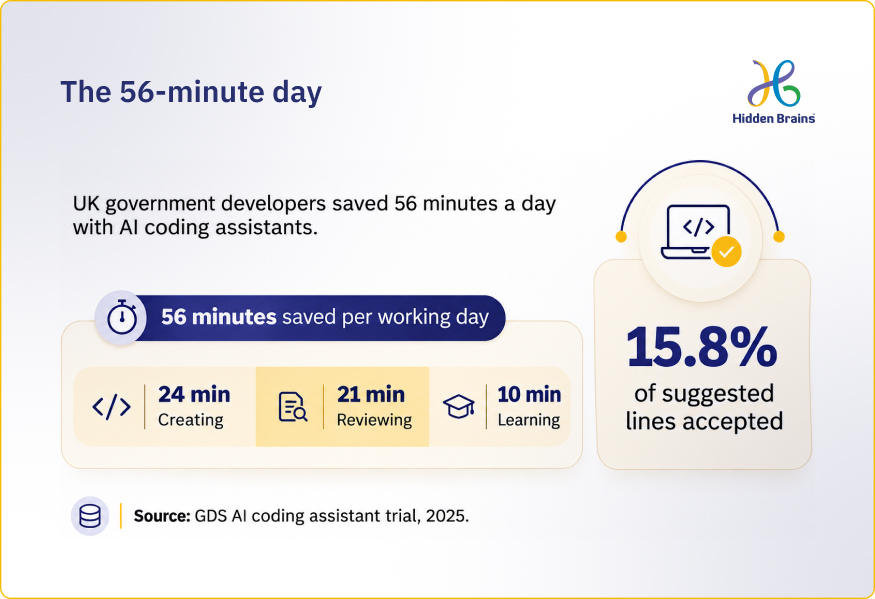
The UK’s largest public-sector test of AI-assisted software development found meaningful savings. The Government Digital Service trial ran from November 2024 to February 2025 across more than 50 public-sector organisations. Participants reported saving an average of 56 minutes per working day, roughly 28 working days a year.
The detail is more instructive than the headline. Of those 56 minutes, 21 went on reviewing code or analysis, not writing it. GitHub Copilot telemetry showed an average acceptance rate of 15.8% for suggested lines. Only 39% of users said they committed code the assistant suggested. The report also notes that the savings were self-reported and may be overstated.
The lesson for a UK business: the tools save time, but a large share of that time moves into review. Someone skilled still has to do it.
Why experienced developers sometimes get slower
A randomised controlled trial by METR tested 16 experienced open-source developers on 246 real tasks in codebases they knew well. With early-2025 AI tools allowed, they took 19% longer to finish. They had expected to be 24% faster.
This does not prove AI slows everyone down. The study covered a specific group working in large, mature projects. It does show that perceived speed and measured speed can differ, which is why you should measure delivery, not impressions.
The security gap in AI-generated code
AI-generated code often works but is not always safe. In Veracode’s 2025 GenAI Code Security Report, more than 100 large language models completed 80 coding tasks. They introduced security vulnerabilities in 45% of cases. Newer and larger models did not perform meaningfully better.
Developers are aware of this. In the 2025 Stack Overflow Developer Survey, trust in the accuracy of AI output fell to 29%, down from 40% in earlier years.
AI coding agents vs traditional developers: what do they really cost UK businesses?
AI coding agents look far cheaper per seat than a developer’s salary. That comparison misleads, because agent costs scale with usage and a person still has to review the output.
On the people side, the ONS Annual Survey of Hours and Earnings 2025 puts the median full-time salary for programmers and software development professionals at around £56,900 (provisional, April 2025). Employer National Insurance, pension, recruitment and management time come on top of that.
On the agent side, seat prices are modest, but agent work is increasingly usage-billed. On GitHub Copilot’s plans, for example, agent mode and code review draw on usage credits, while basic completions do not. Gartner now predicts AI coding costs will exceed the average developer’s salary by 2028 as token consumption rises without governance.
| Cost factor | AI coding agents | Traditional development team |
|---|---|---|
| Pricing model | Seat licence plus usage (tokens or credits) | Salary or day rate |
| Predictability | Low without usage limits and monitoring | High, budgeted per head or per sprint |
| Hidden costs | Review time, rework, security scanning, prompt and context setup | Recruitment, onboarding, notice periods, management |
| Scales by | Spending more on usage | Hiring or contracting more people |
| Who carries the risk of a defect | Your business, through the reviewer who approved it | Your business, through the team that owns it |
The realistic comparison is not “agent vs salary”. It is the cost per change shipped to production, including the hours spent reviewing and fixing what the agent produced.
Accountability, IP and UK GDPR: who owns code an agent writes?
Your business does. Using an AI coding agent does not move legal or operational responsibility onto the tool or its vendor. For UK businesses, that raises three practical questions most comparisons skip.
1. Does UK GDPR apply to AI coding agents? Yes, whenever personal data is involved. The ICO’s January 2026 Tech Futures report on agentic AI made clear that these systems sit under the existing UK GDPR framework, as Skadden’s summary of the report sets out. The ICO has also committed to dedicated guidance on agentic AI in 2026/27. If an agent can read a production database, logs, or customer records, it is processing personal data. Your lawful basis, data minimisation, and any international transfer to the model provider all need checking.
2. What can the agent see and do? An agent with broad repository, cloud, or database permissions is a new access risk. Treat it like a new team member: least-privilege access, no production secrets in prompts, and every change through the same review and CI pipeline as human code.
3. Who owns the output? Ownership and indemnity depend on your tool’s licence terms and on your contracts with any development partner. Check both before agent-written code goes into a product you sell or license.
This is where governance stops being paperwork. Without it, agent adoption turns into what one UK consultancy calls “agent sprawl“: many tools, unclear permissions and no single record of who approved what.

A task-by-task decision framework for UK businesses
Decide task by task, not team by team. Gartner’s own advice is to classify development work into developer-led, shared, and largely agent-led models. The table below applies that idea to typical project work.
| Task | Recommended mode | Why | Human check required |
|---|---|---|---|
| Unit tests for existing code | Agent-led | Easy to verify, low risk | Review coverage and assertions |
| Boilerplate, CRUD endpoints, forms | Agent-led | Repeatable patterns | Code review before merge |
| Documentation of legacy code | Agent-led | Low risk, high time saving | Spot-check accuracy |
| Dependency upgrades and refactoring | Shared | Fast with agents, but side effects are hard to see | Full test run and senior review |
| Bug fixes with a clear reproduction | Shared | Agent drafts, engineer confirms the root cause | Engineer signs off the fix |
| New features in core business logic | Developer-led, agent-assisted | Needs domain judgement | Product owner and engineer |
| Integration with legacy or third-party systems | Developer-led | Undocumented behaviour and data quirks | Integration testing |
| Authentication, payments, personal data handling | Developer-led | Security and UK GDPR exposure | Security review |
| System architecture and technology choices | Developer-led | Long-term cost of a wrong decision | Architect and leadership |
Two questions settle most borderline cases. How quickly would we know if this were wrong? And what would it cost if we didn’t find out? The slower the feedback and the higher the cost, the further down this table the task belongs.

Why the hybrid team model usually wins
A hybrid team, where experienced engineers direct and review AI coding agents, usually beats either option on its own. Agents add speed. The team supplies the judgment that turns that speed into reliable software.
Google’s research backs this up. The 2025 DORA State of AI-assisted Software Development report, based on nearly 5,000 technology professionals, found that AI acts as an amplifier. It magnifies an organisation’s existing strengths and weaknesses. Teams with good testing, clear architecture, and fast feedback gain the most. Teams with fragile pipelines tend to ship more problems, faster.
So the question “can AI coding agents replace software developers?” has a practical answer: not the ones who design, review, and own your systems. What changes is the shape of the team. You need fewer people producing routine code and more people who can:
- write clear specifications and acceptance criteria for agents to work from
- review AI-generated code critically, including for security
- maintain the test suites and CI pipelines that make agent output safe to merge
- make architecture decisions the agent cannot make
For many UK businesses, building that capability in-house is the slow part. This is where a custom software development partner with established AI-assisted delivery practices can shorten the learning curve. The dedicated development team model is a useful alternative when you need capacity that stays accountable.
How to start: five questions before adding AI coding agents in a UK business
Start with a bounded pilot and measure delivery outcomes, not developer impressions. These five questions keep the pilot honest.
- Which bottleneck are we solving? A backlog of routine work, slow test coverage, or a skills gap each needs a different setup.
- What will we measure? Lead time from ticket to production, change failure rate, and review hours per change. These matter more than lines of code.
- What data and systems can the agent reach? Map access against UK GDPR obligations before the pilot, not after it.
- Who reviews and signs off? Name the engineers accountable for agent output, and protect their review time.
- What is our usage budget? Set token or credit limits and monitoring from day one, so costs stay forecastable.
At Hidden Brains, our work on AI-assisted delivery usually starts with this conversation rather than a tool choice. We look at where the delivery process is breaking down, then decide what belongs with agents and what stays with engineers. Over 23+ years of delivery, our practices are backed by CMMI Level 3, ISO 27001, and ISO 9001. We have also achieved ISO/IEC 42001 certification for responsible AI management, which shapes how we govern AI inside client engagements. You can explore our bespoke software development services in the UK or learn more about Hidden Brains UK.
If you are weighing related decisions, our guides on bespoke software vs SaaS and nearshore vs offshore development cover the build and sourcing side.
Table of Contents


