
In today’s fast-moving UK digital economy, business leaders face a critical architectural decision: should you subscribe to an off-the-shelf Software as a Service (SaaS) platform, or build tailor-made bespoke software designed exclusively around your operational workflows?
Choosing the right technology stack is no longer just an IT maintenance decision; it directly dictates your profit margins, operational agility, and long-term valuation. With the UK cloud economy accelerating, the UK SaaS market was valued at $26.9 billion in 2025 and is projected to reach $49.3 billion by 2033, according to market analysis by Grand View Research. The sheer volume of software choices can be daunting.
At the same time, mid-market UK enterprises spend anywhere from £100,000 to over £600,000 annually on SaaS subscriptions, only to discover that annual subscription fee hikes, seat-based pricing traps, and rigid functional limits begin to erode their competitive edge.
This comprehensive business software comparison cuts through vendor marketing claims. We will evaluate bespoke software vs SaaS, examine the true 5-year Total Cost of Ownership (TCO), explore UK compliance mandates like UK GDPR, and provide an actionable decision framework for British executives assessing their software development services options.
Understanding the Core Definitions: SaaS vs Custom Software
To make an informed choice between SaaS vs custom software, it helps to understand how each model alters your technology infrastructure, financial balance sheet, and day-to-day operations.
What is SaaS (Software as a Service)?
SaaS is a cloud-based software delivery model where a third-party vendor hosts, manages, and updates applications, licensing them to users via a recurring subscription (typically monthly or annually).
- The Analogy: Renting a fully furnished city-centre office space. You can move in immediately, utilities and security are handled for you, but you cannot knock down walls, paint the exterior, or reconfigure the floor plan without landlord approval.
- Examples: Salesforce, HubSpot, Microsoft 365, Xero, Workday.
What is Bespoke Software?
Bespoke software (also referred to as custom or tailor-made software) is built from the ground up to satisfy the exact requirements, workflows, and strategic goals of a single organisation. You retain 100% ownership of the source code, intellectual property (IP), and data architecture.
- The Analogy: Designing and building a custom commercial HQ on your own land. It costs more upfront and takes longer to erect, but every single room, doorway, and utility is engineered specifically around how your staff operate.
- Examples: A custom logistics dispatch system integrated with proprietary IoT sensors, a tailor-made private banking portal, or a specialised ERP for NHS supply chain vendors.
For companies requiring deeply specialized functionality or legacy modernisations, leveraging tailored software solutions allows you to turn proprietary business logic into a permanent intellectual asset.

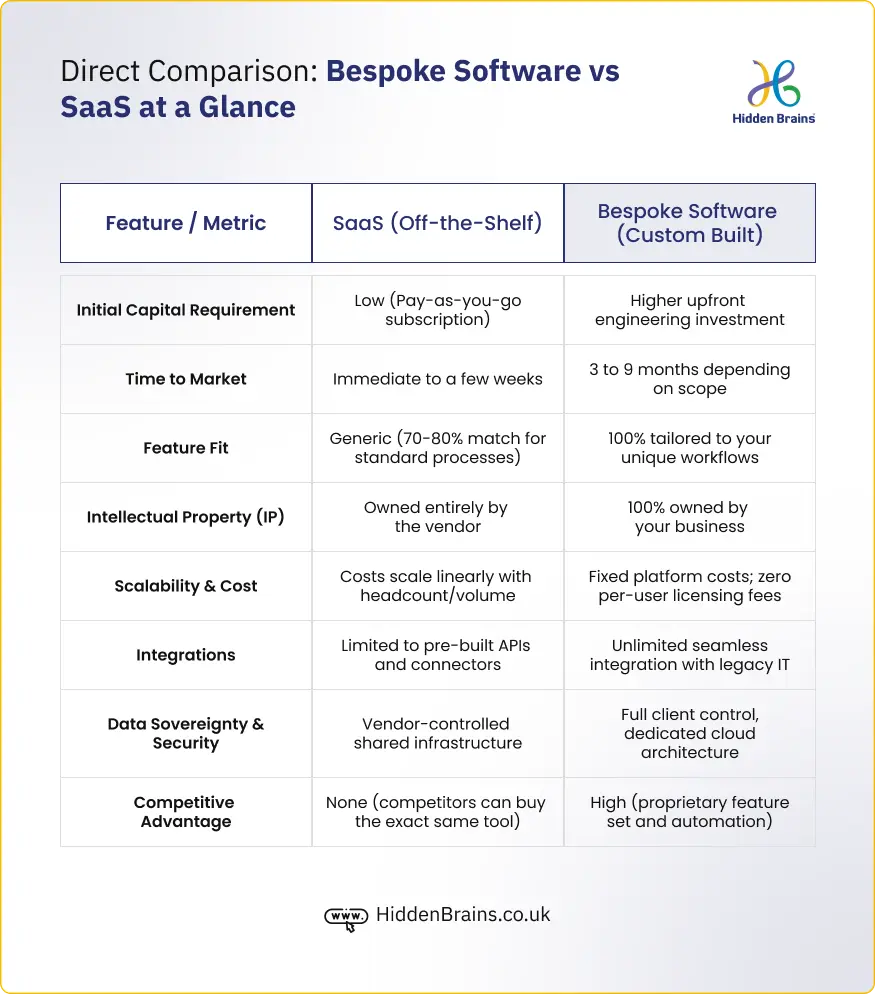
Direct Comparison: Bespoke Software vs SaaS at a Glance
Financial Analysis: Upfront CapEx vs Long-term OpEx
When evaluating bespoke software vs SaaS, initial surface-level cost estimates can be deceptive. SaaS platforms market low entry fees, making them look budget-friendly on paper. However, as your UK enterprise grows, subscription expenses scale exponentially.
The Real Cost of SaaS: Subscription Creep and Hidden Fees
SaaS applications operate on an Operational Expenditure (OpEx) model. While initial onboarding is low-cost, UK firms frequently encounter several financial traps over time:
- Per-seat Inflation: Most SaaS platforms bill per user per month. A platform costing £50/user/month for 50 employees (£30,000/year) quickly jumps to £180,000/year as your staff grows to 300 users.
- Annual Price Increases: SaaS vendors regularly raise renewal prices by 10% to 25% annually once your business operations become deeply reliant on their platform.
- Tier Locking & Add-Ons: Essential enterprise capabilities such as single sign-on (SSO), advanced audit logs, dedicated support, or custom API limits are frequently locked behind top-tier plans that cost triple the base rate.
- Data Export & Lock-in Penalties: Migrating off a legacy SaaS platform can incur exorbitant data extraction fees and technical consulting expenses.
The Real Cost of Bespoke Software: Upfront Investment for Long-term Value
Bespoke software relies primarily on a Capital Expenditure (CapEx) investment model. Custom software projects typically range from initial focused applications to enterprise-grade ERPs built for scale.
However, once the system is deployed, ongoing license costs drop to zero. Your recurring expenditure is limited strictly to cloud hosting (e.g., AWS UK or Azure UK) and routine maintenance (typically 15% to 20% of initial build cost annually).
5-year TCO Comparison
The following financial scenario models the 5-year Total Cost of Ownership for a 150-user UK mid-market business, applying the standard IEEE 15% annual maintenance rule for custom software against a typical enterprise
SaaS subscription with a conservative 10% annual price escalation:
| Cost Breakdown | Enterprise SaaS Platform | Custom Bespoke System |
| Year 1 Setup & Development | £20,000 (Onboarding & data migration) | £120,000 (Design, build, testing) |
| Year 1 Subscription / Hosting | £72,000 (£40/user/month) | £4,800 (Cloud hosting) |
| Year 2 Total Spend | £79,200 (Assumes 10% price hike) | £18,000 (Hosting + Maintenance) |
| Year 3 Total Spend | £87,120 | £18,000 (Hosting + Maintenance) |
| Year 4 Total Spend | £95,832 | £18,000 (Hosting + Maintenance) |
| Year 5 Total Spend | £105,415 | £18,000 (Hosting + Maintenance) |
| Total 5-Year Investment | £459,567 | £196,800 |
| Asset Ownership | £0 (Rented tool) | 100% Proprietary Balance Sheet IP |
In this realistic scenario, the break-even point occurs between Month 24 and Month 36. By Year 5, bespoke software delivers over £260,000 in net savings alongside full IP ownership.
Core Operational Factors for UK Enterprises
Beyond financial considerations, UK business leaders must evaluate how their technology strategy impacts operational scalability, data compliance, and competitive positioning.

Operational Fit and Workflow Alignment
SaaS platforms force your team to adjust their operational habits to suit the software developer’s pre-packaged workflows. If your business relies on bespoke operational models, such as specialized risk modeling in the City of London or custom manufacturing workflows in the West Midlands, standard SaaS tools will force your team to rely on fragmented spreadsheets and manual workarounds.
Conversely, custom development crafts software directly around your established business rules. It eliminates operational friction, reduces manual data entry, and accelerates process execution speeds across your workforce.
Integration Capabilities & Legacy Ecosystems
Modern UK businesses rarely run on a single isolated system. Your tech ecosystem likely includes accounting systems (like Xero or Sage), logistics tools, legacy SQL databases, and customer support channels.
- SaaS Integration Limitations: SaaS products offer standardized webhooks and APIs, but connecting them to legacy, on-premise, or non-standard UK software often requires expensive middle-layer tools or complex middleware integrations.
- Bespoke Seamlessness: Custom platforms can be engineered specifically to speak the language of your existing architecture, seamlessly passing structured data across your entire enterprise network.
Deploying comprehensive enterprise software solutions ensures all internal systems communicate natively without performance bottlenecks or sync failures.
Data Sovereignty, UK GDPR, and Security Standards
Data compliance in the UK carries strict regulatory mandates. Following Brexit, UK organizations must comply with the UK GDPR and the Data Protection Act 2018.
- The SaaS Compliance Risk: When utilizing global SaaS platforms, your corporate data often traverses multi-tenant cloud servers located outside the UK or EU. If a SaaS provider modifies their data hosting practices, your business risks non-compliance, regulatory fines, and legal liability.
- The Bespoke Advantage: Custom software gives you complete control over your data pipeline. You decide exact hosting locations (e.g., AWS London eu-west-2 region), encryption standards, role-based access controls, and retention rules, ensuring full alignment with Cyber Essentials Plus, ISO 27001, and UK GDPR standards.
Decision Matrix: Which Path Should Your UK Business Take?
To determine whether your company should buy a SaaS license or commission custom software, work through this decision framework:
Choose SaaS If:
- Your business needs an immediate solution deployed within hours or days.
- The application handles non-differentiating operational tasks (e.g., standard email marketing, basic accounting, standard HR ticketing).
- You lack the initial capital budget for bespoke engineering.
- You prefer predictable, low initial upfront expenditure over long-term cost optimization.
Choose Bespoke Software If:
- Your core workflows represent your unique market value proposition (USP) that competitors cannot replicate.
- You are spending over £50,000 annually on SaaS user licenses and add-on subscriptions.
- You require tight integrations between legacy systems, hardware sensors, and cloud infrastructures.
- You handle sensitive financial, medical, or legal data that demands strict UK data residency controls.
- You plan to scale operations significantly over the next 3 to 5 years without incurring linear software cost increases.
For organisations seeking independent strategic direction before committing to code, engaging expert business technology consulting helps clarify your TCO, identify technical risks, and align digital investments directly with business growth targets.
Why Choose Hidden Brains for Modern Software Solutions?
Choosing between custom software and off-the-shelf SaaS isn’t just about picking code, it’s about choosing a long-term engineering partner who understands the UK business landscape.
Hidden Brains UK helps British companies transform complex operational challenges into high-performing digital assets. Here is why enterprise leaders choose Hidden Brains as their technology partner:
Proven UK Industry Expertise
With over two decades of experience delivering enterprise applications, we understand the specific commercial, operational, and regulatory pressures facing UK businesses, from London’s fintech hubs to manufacturing centers across the UK.
Complete Intellectual Property & Code Ownership
Unlike vendor lock-in SaaS platforms or restricted development agreements, Hidden Brains transfers 100% of the IP and source code ownership directly to your company upon project completion. Your software becomes a valuable strategic asset on your company’s balance sheet.
Transparent, Agile Engineering Practices
We eliminate project risk through agile delivery methodologies, weekly sprint demos, transparent milestone tracking, and rigorous quality assurance testing. You maintain full visibility over scope, timelines, and budgets from discovery to deployment.
Enterprise-grade Security & UK Compliance
Our development processes follow strict security protocols, including ISO/IEC 42001:2023 and 27001:2022 certified standards, UK GDPR data privacy rules, OWASP top-10 security guidelines, and robust encryption frameworks to safeguard your corporate data.
Flexible Engagement Models
Whether you need a complete end-to-end custom platform built from scratch, system modernization consulting, or dedicated engineering capacity, you can hire dedicated developers from our elite talent pool to extend your team’s delivery capabilities smoothly.
Conclusion
Choosing between SaaS and bespoke software isn’t just a technical decision; it is a fundamental commercial strategy. While off-the-shelf SaaS applications offer quick setup and low initial entry costs for standard administrative tasks, they can rapidly become expensive, rigid constraints as your enterprise scales.
Conversely, custom bespoke software transforms core operational processes into valuable intellectual property, delivering complete data sovereignty, seamless legacy integrations, and superior long-term ROI. By carefully evaluating your five-year total cost of ownership and unique operational workflows, UK business leaders can make an informed technology investment that safeguards profit margins, drives efficiency, and powers sustainable competitive growth.

Frequently Asked Questions
What is the fundamental difference between bespoke software vs SaaS?
The primary difference lies in ownership, customization, and financial structure. SaaS (Software as a Service) is a rented, standardized platform managed by a third party where you pay recurring subscription fees per user. Bespoke software is built specifically for your business, providing 100% custom features, complete IP ownership, and zero ongoing licensing costs.
Is bespoke software more expensive than SaaS in the long run?
While bespoke software requires a higher upfront initial investment, it is often significantly cheaper over a 3- to 5-year period for growing companies. SaaS costs increase linearly as you add users, upgrade tiers, and face annual vendor price hikes. Bespoke software carries zero user license fees, making its Total Cost of Ownership (TCO) far lower as your team expands.
Which option provides better security and UK GDPR compliance?
Bespoke software gives you total control over security architecture, data hosting locations, and compliance protocols. You can ensure data is hosted exclusively in UK cloud regions (such as AWS London) to satisfy UK GDPR and Data Protection Act rules. While major SaaS providers maintain high security, your data shares multi-tenant infrastructure alongside thousands of other businesses, limiting your control over data handling.
How long does it take to develop bespoke business software compared to deploying SaaS?
SaaS tools can be provisioned almost instantly or within a few weeks for standard setups. Bespoke software development typically takes between 3 to 9 months depending on system complexity, integration requirements, and feature scope. However, agile development allows custom MVP (Minimum Viable Product) releases to go live in stages, delivering operational value early.
Can a business transition from a SaaS platform to bespoke software later?
Yes, transitioning from SaaS to bespoke software is a common milestone for scaling businesses that outgrow off-the-shelf capabilities. The process involves auditing existing SaaS workflows, engineering a custom system to handle your unique requirements, extracting and sanitizing historical data from the SaaS platform via APIs or databases, and conducting a phased user migration.
How do I decide whether to buy SaaS or build bespoke software for my UK business?
Evaluate three factors: uniqueness of process, scale, and budget. If your process is a standard administrative task (e.g., generic accounting), choose SaaS. If the process represents your core competitive advantage, involves complex legacy integrations, or carries high recurring SaaS licensing fees across a large team, building bespoke software delivers superior ROI, security, and market differentiation.
Table of Contents