


“Launching a new product in today’s UK market isn’t just about having a great idea; it’s about getting it to market before the moment passes. This article breaks down how AI-driven MVP development gives startups and scaling businesses a smarter path to launch: faster timelines, leaner teams, lower risk, and product decisions backed by real user data rather than costly assumptions. From the first brief to post-launch iteration, you’ll see exactly how AI transforms every stage of the build, and why the businesses moving fastest right now aren’t the biggest ones; they’re the ones building with AI at the core.”
Most great ideas don’t fail in the market. They fail on the way to it.
In the UK, nearly 60% of startups don’t survive their first few years, not because the market wasn’t there, but because by the time the product was, the moment had passed.
The timeline drags. The budget bleeds. The team builds and rebuilds. And by the time the product is finally ready, the window that made the idea exciting in the first place has quietly closed.
This is the silent killer of innovation in the UK’s tech world, not bad ideas, but slow execution and the wrong direction.
AI-driven MVP development exists to fix exactly that.
It’s not a shortcut that sacrifices quality. It’s a smarter build process, one that takes your idea from concept to validated, market-ready product in weeks, not months. It brings the right people, the right technology stack, and real user data into the process from day one, so every decision you make is backed by evidence, not assumption.
In this article, we’ll show you how it works at every stage of the build, what the numbers actually look like, and why the businesses launching fastest right now aren’t the biggest ones; they’re the ones building with AI at the core. And how do software development company align to fit in this?
What Exactly Is an AI-driven MVP? And Why Do You Build It?
Before we dive into the AI-driven MVP development, let’s get clear on something.
An MVP, a Minimum Viable Product, isn’t about cutting corners. It’s not some “half-baked” version of your idea. It’s the smartest, leanest version of your product that proves your core concept works with real users. Think of it as your hypothesis made tangible.
Instead of building everything, you’re building the right things fast enough to get feedback that matters. The biggest mistake startups fail isn’t about hiring, resourcing, or strategising. It’s about launching late and making wrong assumptions.
AI-driven MVP development eliminates that gamble. It replaces gut instinct with live data. It replaces the traditional six-month build cycle with a couple of week launches. It replaces expensive, post-launch fixes with real-time feedback loops that catch issues before they become crises.
How AI Powers Every Stage of Your MVP: From Idea to First User
We get it, understanding the “what” is important, but seeing how AI actively transforms each stage? That’s where the real opportunity becomes clear.
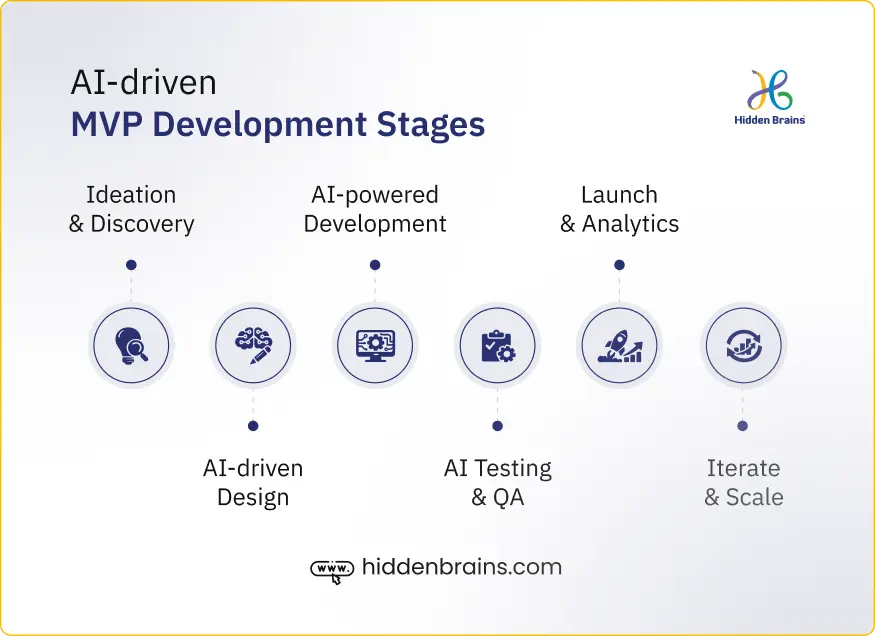
Stage 1: Ideation and Discovery
Most new product journeys start with a group of smart people making educated guesses about what the market needs. AI changes this entirely.
Before a single wireframe is drawn, AI tools analyse market trends, user behavior patterns, and competitive gaps to validate whether your idea has real traction. You’re not guessing which features your audience wants; you’re seeing data that tells you which ones will drive adoption, and which ones will collect dust.
For UK businesses in fast-moving sectors, fintech, health tech, SaaS, ecommerce, this means entering your build phase with confidence, not hope.
Stage 2: Design and UX
Traditional design is a slow, iterative process filled with assumptions and revisions. AI tools like v0.dev and Galileo AI generate functional UI/UX components based on real user interactions, not designer assumptions.
What used to take weeks of wireframing now takes days. Your product’s first impression is already working for you before a single line of code is written.
Stage 3: Development and Code Generation
AI tools like Cursor and GitHub Copilot don’t just speed up development; they redefine its economics. Developers using AI tools complete tasks up to 55% faster. That’s not a marginal improvement; that’s a game changer.
The repetitive, structural backbone of your application? AI handles it. You hire senior developers who focus on the innovation that makes your product uniquely valuable in the market. A lean, AI-equipped team of five performs at the capacity of a team of eight or more. For UK startups, that’s not just efficiency, it’s a strategic edge.
Stage 4: Testing and Quality Assurance
A bug fixed after launch can cost 2x more than one caught during development. AI-powered testing, using tools like testRigor, runs continuously throughout the development process, catching defects in real-time and self-healing test scripts without manual maintenance overhead.
Scenario: You launch with confidence, not crossed fingers.
Stage 5: Launch and Real-time Analytics
The moment your MVP hits the market, the learning begins. With AI, that loop is immediate. Instead of waiting weeks to draw conclusions, AI analytics surfaces user behavior insights from the very first session. You see what’s working, where users drop off, which features they actually use, and you iterate within days, not quarters.
Stage 6: Iteration and Scale
An MVP isn’t the end, it’s the beginning of a conversation. AI-native architecture means your product is built to scale from the start, not retrofitted at the last minute when growth arrives. Every iteration is faster. Every decision is smarter. And every pound you invest in growth goes further.
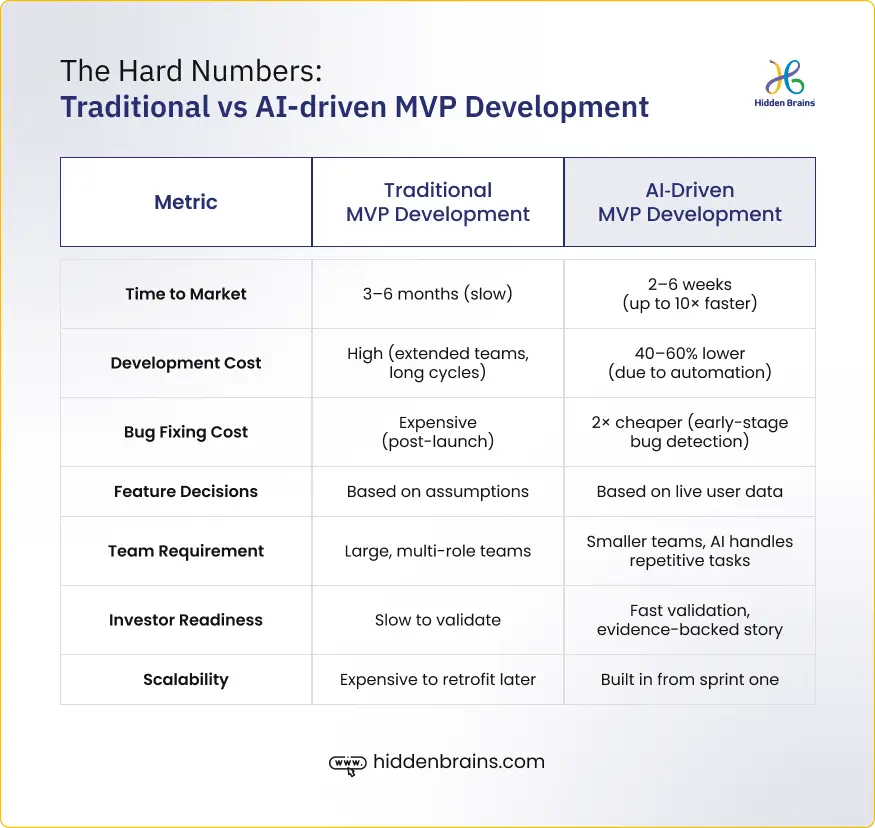
The Hard Numbers: Traditional vs AI-driven MVP Development
Numbers speak for themselves. Whether you are a startup or scale up, for you, KPIs and metrics are equally important. AI-driven MVP Development answers it all.
Specialised Resources and Tools Business Needs for AI-driven Development
Every business is unique, and so are its development requirements. This is why having a dedicated team of experts who can tailor AI-driven MVP development to your specific needs is crucial. Here’s why:
1. Customisation: An expert team can create solutions tailored to your market, industry regulations, and customer needs. In the UK, this means understanding local compliance requirements, security standards, and user psychology.
2. Expertise in Security & Compliance: The UK’s GDPR and other compliance regulations require careful attention. Having a team that understands how to incorporate these into your MVP, without sacrificing agility, makes all the difference.
3. Human-centric Development: AI tools are powerful, but they need to be harnessed by people who understand user psychology. A dedicated team ensures the right AI tools are being used effectively to meet real user needs.
4. Adaptive Tools: Different businesses have different requirements, but the right AI tools and resources are adaptable to various industries. The key is using them with a strategic mindset and the right developers to ensure you’re staying ahead in the market.
Strategic Wins: Real Takeaways for Your Business
1. Speed to Market: AI enables rapid prototyping and iteration, meaning you can get feedback immediately and launch quickly. This is especially crucial for UK startups aiming to gain early market entry and validate their product fit before competitors do.
2. Lower Risk, Higher Confidence: Traditional MVP development can be risky, especially with no guarantees on market fit. AI-driven MVPs reduce that uncertainty by providing real-time insights from live users, making pivots and adjustments easier.
3. Cost Savings: AI tools dramatically reduce manual labor, enabling smaller teams to do the work of larger ones. For startups, this means lower development costs and the ability to allocate resources to other key business areas.
4. Better User Experience: AI tools can provide actionable user behavior data that directly informs the UX/UI design, ensuring your MVP resonates with your target audience from day one.
Conclusion: The Future is AI-driven MVPs
The truth is simple: AI-driven MVP development isn’t just a shortcut; it’s a strategic necessity for businesses looking to dive into the fast-paced hustle culture or turn big ideas into reality, step by step. The speed, cost-effectiveness, and reduced risk it brings make it a game-changer, especially for startups and mid-sized businesses eager to validate ideas quickly and move with clarity.
But here’s the key: AI tools are only as powerful as the team behind them. This is where Hidden Brains steps in.
We bring together strategists, business insights, and expert resources, seamlessly blending them into a product that’s strategically aligned with market needs. With 22+ years of experience, we don’t just build software; we create custom software solutions that drive sustainable growth and innovation.
Looking for a software development company in the UK with a smarter approach to innovation and sustainable success? With Hidden Brains by your side, you’ve got a team that’s ready to turn your vision into action.
FAQs
What is AI-driven MVP development, and why is it important for startups?
AI-driven MVP development is the process of building a Minimum Viable Product using artificial intelligence tools and data models to automate features, personalise user experiences, and generate predictive insights from day one. It enables startups to test smarter product versions, gather real-time behavioral data, and iterate faster based on machine-driven insights, reducing risk while accelerating product-market fit.
How can AI MVP development help reduce time-to-market for businesses in the UK?
By leveraging AI tools, businesses in the UK can launch their MVP in as little as a couple of weeks, speeding up development and allowing them to test ideas quickly in the market.
What are the benefits of using AI for MVP testing and bug detection?
AI-powered testing tools can catch bugs faster than traditional testing, allowing businesses to launch with more confidence and avoid costly post-launch fixes.
How does AI-powered MVP development improve user experience and product-market fit?
AI offers real-time insights into user behavior, helping businesses make data-driven decisions, improve user experience, and adjust product features based on actual customer feedback.
How much can AI-driven MVP development reduce development costs?
Using AI tools for MVP development can cut costs, making it a more affordable approach for businesses looking to innovate quickly without breaking the bank.
How Can Hidden Brains Help Me with MVP Development?
With over 6000+ successful projects, Hidden Brains brings hands-on expertise in developing MVPs for both startups and enterprises. We specialise in AI-driven solutions, rapid prototyping, and data-driven decisions to ensure your MVP is not just functional, but strategically aligned with your business goals. Our experience guarantees a tailored, market-ready solution that delivers results.
How Long Does It Take to Build an MVP?
The timeline for MVP development can vary depending on factors like scope, complexity, and technology requirements. Typically, we help businesses launch their MVPs within a couple of weeks, but we tailor the timeline to meet your specific needs and ensure quality. The key is to focus on delivering the core features quickly while leaving room for iterations based on user feedback.
Table of Contents