

Hidden Brains Achieves ISO/IEC 42001:2023 certification, strengthening the governance foundation behind how we design, develop, deploy and manage AI solutions. The certification validates our Artificial Intelligence Management System (AIMS) against an internationally recognised standard for responsible AI governance, risk management, accountability, monitoring and continual improvement.
For enterprises working with us, this adds another layer of assurance on top of our existing engineering, information security and quality practices. It means AI governance is not an afterthought bolted on after a system is built. It becomes part of the management framework that surrounds how AI initiatives are assessed, built, reviewed and improved, and it sits alongside our existing certifications in information security (ISO/IEC 27001) and quality management (ISO 9001).
As AI moves deeper into customer operations, financial workflows, enterprise applications, automation and decision-support systems, organisations increasingly need to answer more than whether an AI solution can be built. They need to know how it will be governed, who is accountable for it, how risks will be managed, and what happens after it goes live.
What is ISO/IEC 42001?
ISO/IEC 42001:2023 is the world’s first AI management system standard. Published in December 2023 by ISO and the IEC, it specifies requirements for establishing, implementing, maintaining and continually improving an Artificial Intelligence Management System within an organisation.
In plain terms, it certifies how an organisation manages AI, its risks, its impact on the people it affects and its behaviour across the full lifecycle, rather than certifying any single AI model. A few points worth keeping straight:
- It operates at the organisational and process level, not the level of an individual model or feature.
- It covers governance, accountability, risk management, monitoring and continual improvement.
- It is auditable, an accredited third-party body assesses the management system and issues certification, typically valid for three years.
- It is not a certificate that a particular AI product is “safe” or “compliant” in the abstract.
If ISO 9001 points quality-management discipline at delivery and ISO 27001 points it at information security, ISO 42001 points the same machinery at AI. What matters is not the certificate on the wall, it’s what changes in how AI actually gets built.
Know more about our awards certification: Awards & Accolades
Why AI governance matters now
AI governance matters now because AI has stopped being a side experiment and started making, or influencing, real business decisions. It increasingly sits inside:
- Customer support workflows
- Financial and operational decisions
- Enterprise search and RAG systems
- Autonomous and semi-autonomous agents
- Document processing and forecasting
- Recruitment and employee-productivity tools
- Third-party AI platforms embedded in core systems
Once AI is in those places, a different set of questions becomes unavoidable:
- Who owns the outcome if the AI behaves unexpectedly?
- What data can the model access?
- When must a human intervene?
- How are external AI providers assessed?
- What happens when the underlying model changes?
- How are performance, incidents and risks monitored after launch?
Seen this way, ISO 42001 is a response to an operating problem, not a compliance box-ticking exercise. It gives these questions a home in a management system instead of leaving them to individual developers or project teams to answer each time differently.
ISO 42001 and EU AI Act readiness
ISO/IEC 42001 certification strengthens EU AI Act readiness, but it is not the same as EU AI Act compliance, and it’s worth being precise about that, because a lot of marketing blurs the two.
Our ISO/IEC 42001-certified AI management system strengthens the governance foundation organisations need when navigating AI regulation, including obligations arising under the EU AI Act. The standard supports areas the Act also cares about: risk management, defined responsibilities, documentation, lifecycle controls, monitoring, corrective action, supplier oversight and continual improvement.
The EU AI Act, however, introduces specific legal obligations that depend on the organisation’s role (provider, deployer, importer) and on how a given AI system is classified under its risk tiers. The Act entered into force on 1 August 2024 and applies in phases: prohibited-practice and AI-literacy rules from February 2025, general-purpose AI model obligations from August 2025, general application from 2 August 2026, and the heaviest high-risk obligations phased into 2027–2028. The precise duties for any single system are a legal determination, not something a management-system certificate settles.
So the honest positioning is:
ISO 42001 gives us the management system. The EU AI Act defines legal obligations that may apply to individual AI systems and deployments.
For UK organisations, this still matters directly: the EU AI Act can reach you when you place AI systems on the EU market, serve EU customers, or otherwise fall within its territorial scope — regardless of where your business is based. A certified management system doesn’t remove those obligations, but it gives you a running start at meeting them. Where legal interpretation is needed, our AI strategy and readiness work pairs governance with the specific regulatory questions your systems raise.
How ISO 42001 changes AI development
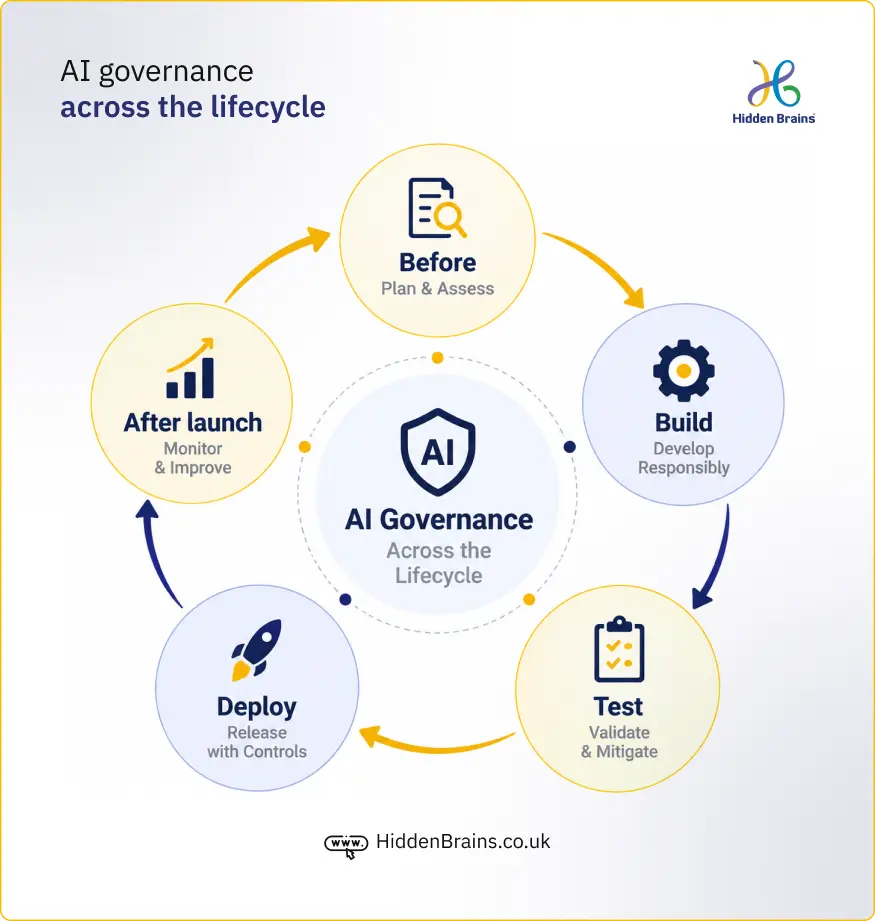
The practical effect of ISO 42001 is that governance shows up at every stage of development, not just in a policy document. Here’s what changes.
Before development. The work doesn’t start with the model. It starts with questions: What is the intended AI outcome? Who owns the system? What decisions can it influence? What data will it access? What risks need treatment? Where is human oversight required?
During architecture and development. Governance considerations shape real technical choices — model selection, data access, APIs and permissions, use of third-party AI services, human-in-the-loop controls, logging, fallback mechanisms and security boundaries. This is where custom AI development services either bakes in governance or leaves gaps to be discovered later.
During testing. Testing extends past “does the feature work?” to output behaviour, failure conditions, known risk scenarios, human escalation paths, access boundaries and monitoring requirements.
Before deployment. There is clarity on ownership, operational controls, monitoring, documentation, escalation and approved usage, agreed before go-live, not after an incident.
After launch. This is the part most teams underestimate. AI governance has to continue when data changes, models are upgraded, prompts or workflows change, new integrations are added, a third-party provider updates its model, or new risks emerge.
What this means for clients
For clients, the certification translates into fewer surprises and stronger evidence. In practice:
- Clearer accountability. You know who owns AI-related decisions, controls, monitoring and escalation.
- Earlier, more structured risk discussions. Risk is assessed up front rather than discovered during a security review or after deployment.
- Better governance evidence. Enterprise risk, security, compliance, internal audit, procurement and executive teams often need documented proof of how AI is managed. A structured management system gives those conversations a stronger foundation.
- Governance beyond go-live. You’re not buying “an AI feature”, you’re putting something into production that may run and evolve for years. The management system is built to keep governing it.
- Better alignment across business, technology and risk. AI governance often fails because technical, business, security, legal and compliance teams work from different assumptions. A shared framework creates common processes and accountability.
Must read: Bespoke Software Vs SaaS
AI governance across models, data and third-party providers
Enterprise AI is rarely one model running by itself, which is exactly why governance has to span models, data and vendors. A modern solution often chains business data through a retrieval layer, a foundation model, APIs, agents and enterprise systems, each introducing dependencies that need governing. Four areas matter most:
Models. Which model is being used? What is it allowed to do? What happens when it changes? How is performance reviewed over time?
Data. What data can the AI access? Is sensitive data involved? Is the data appropriate for the intended purpose? How is access governed? This is where AI governance and our existing ISO/IEC 27001 information-security practices reinforce each other.
Third-party AI providers. Which external services does the solution depend on? What happens if their policies, APIs or models change? What data is shared externally, and what controls sit around those dependencies?
Agentic AI. Once AI can retrieve information, call APIs, update systems, trigger workflows and make multi-step decisions, the stakes rise. A useful principle:
The more autonomy AI receives, the stronger the surrounding controls need to become.
Governing these dependencies is a core part of integrating AI with enterprise systems safely, rather than leaving a promising prototype exposed in production.
How ISO 42001 works with ISO 27001 and ISO 9001
These three standards solve different parts of the same enterprise problem, they don’t replace one another.
| Standard | Primary focus | Why it matters for enterprise AI |
| ISO/IEC 42001:2023 | AI management and governance | Structures AI risk, accountability, lifecycle management and continual improvement |
| ISO/IEC 27001:2022 | Information security | Protects the data, systems, access and information assets that support AI applications |
| ISO 9001:2015 | Quality management | Supports repeatable processes, quality controls and continual improvement across delivery |
The key point: an AI application can be well governed but poorly secured. It can be secure but inconsistently engineered. It can meet quality expectations at launch yet lack proper AI lifecycle controls. Held together, these certifications address different parts of the environment in which enterprise AI actually operates, which is why we treat them as one system rather than three separate badges.
Also read: Nearshore Vs Offshore Software Development
What UK enterprises should look for in an AI development partner
UK enterprises should evaluate an AI development partner on governance maturity, not demos, because the risks live in production, not in the prototype. Use this as a checklist:
| What to look for | Why it matters |
| AI governance framework | AI risks and responsibilities shouldn’t depend on individual developers or project teams |
| Security management | AI applications interact with enterprise data, APIs, identity systems and sensitive information |
| Clear human oversight | You need to know where AI can act independently and where people must intervene |
| Model and vendor governance | Many solutions depend on external models and platforms that change over time |
| Data governance capability | AI quality and risk are tied to the quality, provenance, access and permitted use of data |
| Lifecycle monitoring | AI behaviour drifts as data, models, users and processes evolve |
| Enterprise integration expertise | AI must work safely with CRM, ERP, finance and cloud systems — not stay an isolated prototype |
| Documented accountability | Procurement, audit, risk and compliance teams need to know who owns decisions and incidents |
| Regulatory awareness | Requirements differ by sector and jurisdiction, especially across the UK and EU |
| Evidence beyond AI demos | Enterprises need production engineering, QA, security and operational maturity — not just impressive prototypes |
This is why we treat responsible AI development as a combination of AI engineering, governance, security, quality engineering, data and enterprise integration rather than a standalone model-building exercise. It’s also the thinking behind our enterprise AI consulting in the UK.
Building enterprise AI that can be governed after launch
Deployment is not the end of AI development — it’s the point at which governance matters most. AI systems keep changing after go-live because models are upgraded, enterprise data shifts, users find new patterns, prompts evolve, workflows become more autonomous, vendors change, regulation moves and business priorities reset.
So an enterprise AI system needs to be monitored, reviewed, corrected, improved and — when appropriate — retired. That ongoing responsibility is where monitoring and maintaining AI after launch becomes a governance function, not just a support contract.
Which reframes the real enterprise AI question:
The question is no longer only whether an organisation can get a model into production. It’s whether it can understand, control and govern that system months and years after deployment.
Our ISO/IEC 42001:2023 certification strengthens the management foundation behind exactly that responsibility.
Conclusion
Hidden Brains has achieved ISO/IEC 42001:2023 certification, the international standard for how an organisation governs AI. For you as a buyer, the headline isn’t the badge, it’s that AI risk, accountability and oversight are now handled inside a certified management system rather than left to whichever developer happens to be on your project. That means fewer surprises in production, earlier risk conversations, and documented evidence you can hand to your own risk, audit and procurement teams.
What it changes for you, in practice:
- Accountability is defined up front: who owns AI decisions, monitoring and escalation is agreed before go-live, not after an incident.
- Governance evidence you can reuse: a structured basis for your board, security, compliance and procurement reporting.
- Governance that continues after launch: the system is built to keep governing AI as models, data and vendors change.
- Honest regulatory positioning: it strengthens your EU AI Act readiness without pretending to be legal compliance.

Frequently Asked Questions
Why should this certification matter to me as a buyer?
Because it moves AI governance from a promise to an audited, repeatable process. You get clearer accountability, earlier risk assessment, and documented governance you can put in front of your own audit, risk and procurement teams, which shortens your internal approval cycle for the AI systems we build.
Does working with an ISO 42001-certified partner reduce my risk?
It reduces a specific category of it: governance and lifecycle risk. Accountability, human-oversight points, data-access boundaries and monitoring are decided deliberately and documented, so failures are less likely to be discovered late. It does not transfer your legal obligations to us, you remain the deployer of your own AI, but it gives you a stronger, evidenced foundation to meet them.
Can I use your certification as evidence in my own audit or procurement process?
Yes. Enterprise risk, security, internal audit and procurement teams routinely ask for proof of how AI is managed. A certified AI management system is exactly the kind of third-party-validated evidence those teams are looking for, and it sits alongside our ISO/IEC 27001 and ISO 9001 certifications.
Does this make my AI project EU AI Act compliant?
No, and be wary of any vendor who says it does. ISO 42001 certifies our management system and strengthens the governance areas the Act relies on (risk management, documentation, oversight, supplier controls). But EU AI Act compliance depends on your role and how each specific system is classified. It supports readiness; it doesn’t replace a legal assessment of your system.
We already work with ISO 27001-certified partners. What does 42001 add?
ISO 27001 tells you your data and systems are secured. ISO 42001 tells you the AI itself is governed, its risks, its impact on the people it affects, and its behaviour across the lifecycle. An AI system can be perfectly secure and still make poor or unaccountable decisions. The two standards cover different failure modes; you want both.
Will governance slow down or add cost to my project?
Governance front-loads a small amount of decision-making rather than adding bulk. The questions, who owns this, what data can it touch, where does a human intervene, get answered before building instead of during a security review or after an incident, which is where the expensive delays actually happen. For most enterprise systems, it reduces total time-to-production risk rather than adding to it.
How is this different from a partner that just says “we do responsible AI”?
“Responsible AI” is a claim; ISO 42001 is an audited system a third party has verified. The practical test is whether governance is applied before, during and after development, and whether accountability is documented, not whether it appears on a slide. Ask any vendor for the evidence, not the adjective.
What happens to governance after our system goes live?
That’s where it matters most. Models get upgraded, your data shifts, workflows evolve and third-party providers change their services — any of which can move a well-behaved system off course. A certified management system is built to keep monitoring, reviewing and correcting the system after launch, not to walk away at go-live.
Does this cover generative AI and AI agents?
Yes. It applies to any AI we develop or deploy, including generative and agentic systems. The more autonomy an agent has retrieving data, calling APIs, triggering actions the, more the surrounding controls matter, and that’s precisely what the management system is there to govern.
Table of Contents
