
If you have been keeping an eye on the UK business landscape over the past few years, you will know that the conversation around technology has shifted dramatically. Digital transformation is no longer just about migrating to the cloud or replacing paper processes with digital spreadsheets. Today, the competitive battleground is defined by AI-driven digital transformation.
According to official data from the Office for National Statistics (ONS) and the Department for Science, Innovation and Technology (December, 2025), 25% of all registered UK businesses have actively deployed AI tools, a figure that jumps to 44% among large UK enterprises. What is more, 75% of UK businesses using AI report noticeable improvements in workforce productivity.
Whether you are an Enterprise IT Director, a Chief Digital Officer, or an ambitious UK business owner, this practical guide cuts through the noise. We will examine how AI digital transformation is reshaping modern organisations and set out actionable AI-driven digital transformation strategies designed to help your business stay competitive, compliant, and profitable.
What Is AI-driven Digital Transformation?
To understand where technology is headed, it helps to distinguish traditional digital transformation from its AI-driven counterpart.
- Traditional Digital Transformation focused on digitisation and connectivity, converting analog data into digital formats, moving infrastructure to public or hybrid clouds, and automating basic linear workflows.
- AI-driven Digital Transformation embeds machine learning (ML), generative AI, natural language processing (NLP), and predictive analytics directly into the core engine of your business.
Instead of simply recording what happened yesterday, an AI-first enterprise anticipates what will happen tomorrow. It dynamically reallocates supply chain resources, delivers hyper-personalised customer experiences in real time, and automates complex cognitive tasks previously bottlenecked by manual effort.
| Feature | Traditional Digital Transformation | AI Driven Digital Transformation |
| Primary Goal | Digitise processes & centralise data | Augment human intelligence & automate decision-making |
| Data Usage | Static reporting & historical analytics | Real-time predictive & prescriptive analytics |
| Workflow Style | Rule-based, deterministic logic | Adaptive, self-learning machine algorithms |
| Customer Experience | Reactive multichannel engagement | Proactive, hyper-personalised customer journeys |
| Value Focus | Operational cost reduction | Exponential growth, agility, and innovation |
When executed correctly, embedding intelligent capabilities through tailored software development services allows your business to transition from reactive troubleshooting to proactive market leadership.

Key Pillars of AI-driven Digital Transformation Strategies
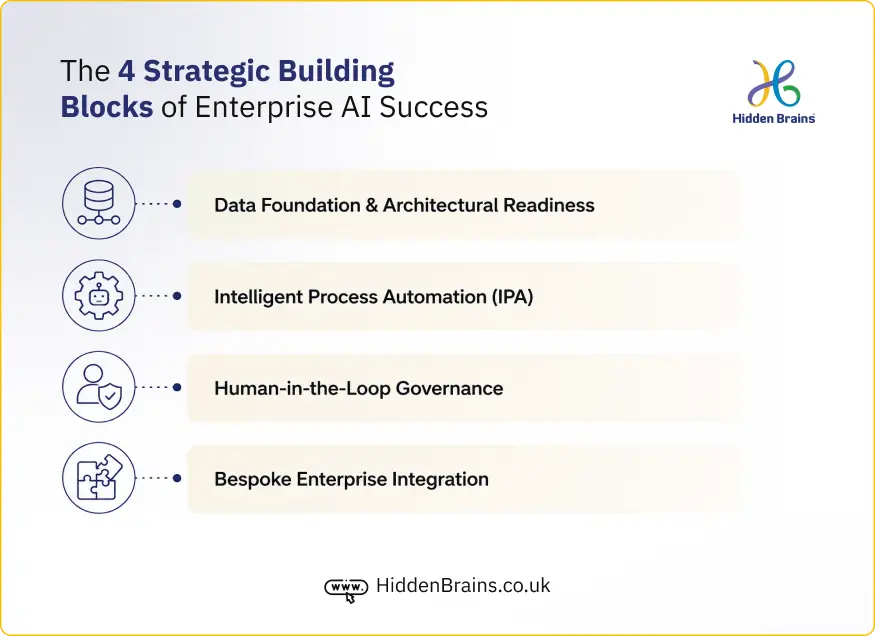
Embarking on an AI transformation journey without a clear framework is one of the quickest ways to join the 68% of UK companies struggling to see positive ROI. To build a resilient, scalable digital enterprise, your strategy should rest on four core pillars:
Data Foundation & Architectural Readiness
AI models are only as good as the data feeding them. Fragmented legacy silos, unstandardised records, and poor data hygiene prevent machine learning models from providing accurate insights. A robust strategy begins with modernising your data architecture creating clean, governed, real-time data pipelines that flow seamlessly across departments.
Intelligent Process Automation (IPA)
Basic Robotic Process Automation (RPA) handles repetitive, structured tasks. Intelligent Process Automation combines RPA with machine learning and generative AI services, enabling your systems to handle unstructured data, such as reading complex invoices, analyzing legal contracts, or triaging customer service emails without manual intervention. By adopting advanced generative AI solutions, businesses can further enhance automation and improve operational efficiency.
Human-in-the-loop Governance & Compliance
In the UK, regulatory compliance is non-negotiable. With strict frameworks like UK GDPR, the Data Protection Act 2018, and evolving AI safety guidelines, your transformation strategy must prioritise ethical AI. Establishing clear human oversight (“Human-in-the-Loop”) ensures that automated decisions remain transparent, explainable, and fair.
Bespoke Enterprise Integration
Off-the-shelf software rarely addresses the unique operational nuances of mid-market or enterprise UK businesses. Connecting legacy core systems with modern, cloud-native microservices requires robust enterprise business solutions custom-engineered to fit your existing infrastructure.
Real-world Impact Across UK Industries
AI digital transformation is not a distant, theoretical concept; it is actively altering unit economics across key sectors in the UK economy:
Financial & Professional Services
The UK financial sector leads the nation in strategic AI adoption. From automated risk modelling in the City of London to banking IT solutions, AI reduces processing times from days to seconds while significantly lowering compliance risks.
Retail & E-Commerce
UK retailers operate in one of the world’s most competitive markets. Leading High Street brands and e-commerce solutions and services leverage AI for predictive demand forecasting, automated stock replenishment, and dynamic pricing strategies that protect margins during fluctuating economic conditions.
Logistics & Manufacturing
In Britain’s manufacturing hubs, industrial IoT sensors paired with machine learning algorithms predict equipment failures before they happen. These logistics software solutions drastically cut unplanned downtime, extend machinery lifespan, and optimise energy consumption.
Healthcare & Public Sector
Across NHS trusts and private health providers, AI-powered diagnostic tools and healthcare app development solutions are alleviating severe staffing pressures, ensuring that front-line workers spend less time on paperwork and more time with patients.
Overcoming Key Challenges: Skills, Legacy Systems & Compliance
While the benefits are compelling, UK leaders face several hurdles when rolling out AI-driven digital transformation strategies:
- The UK AI Skills Shortage: Over 60% of UK businesses cite a lack of internal technical skills as their primary barrier to AI implementation. Finding engineers skilled in machine learning, data engineering, and modern DevOps can take months.
- Legacy Technical Debt: Many established UK enterprises rely on core legacy platforms that were never built for API-first, real-time data streaming.
- Budget Allocation & ROI Expectations: The average payback timeline for mature AI programmes is 2 to 4 years, yet nearly two-thirds of UK boards expect tangible financial results within 7 to 12 months. Managing board-level expectations is vital.
To bridge the skills gap quickly and avoid costly recruitment delays, many UK organisations choose to hire dedicated developers who bring immediate, domain-specific AI expertise to accelerate execution.
How Hidden Brains Can Help UK Businesses Transform
Navigating an AI-driven transformation demands far more than technical code; it requires a strategic tech partner who thoroughly understands the specific regulatory, cultural, and operational dynamics of the UK market.
Founded in 2003, Hidden Brains UK has spent building and modernising software for businesses long enough to have delivered over 6,000 solutions across 39 industries, earning the trust of a 2,400+ client base and counting. We empower UK enterprises, SMBs, and public sector bodies to modernise their operations and capitalise on emerging technology.
- Custom AI & Machine Learning Engineering: We build tailored AI models, recommendation engines, and natural language processing solutions specifically tailored to your business goals.
- Bespoke Software Development: From cloud-native architectures to custom web and mobile applications, our engineering teams deliver robust software development solutions that turn complex challenges into seamless digital workflows.
- Enterprise Modernisation: We migrate legacy infrastructure into agile, cloud-enabled architectures using scalable enterprise solutions.
- Flexible IT Staff Augmentation: Need specialised talent fast? You can easily onboard dedicated developers to extend your in-house capabilities with top-tier AI and software engineers.
- Reliable Long-Term Partnership: Technology moves fast, which is why we provide end-to-end post-launch support to ensure your AI models and enterprise systems stay secure, updated, and performing at their peak.
Conclusion
AI-driven digital transformation is no longer a luxury reserved for Silicon Valley tech giants; it is an urgent operational priority for UK businesses determined to thrive in an increasingly automated economy. By moving away from piecemeal technology tools and adopting a clear, data-first strategy, your organisation can streamline operations, empower employees, and unlock substantial commercial value.

Frequently Asked Questions
How does AI digital transformation differ from traditional digital transformation?
Traditional digital transformation focuses primarily on digitising manual processes, adopting cloud infrastructure, and centralising data. In contrast, AI digital transformation uses that digital foundation to build self-learning, adaptive systems that analyse data in real time, predict outcomes, and automate complex cognitive tasks.
What are the best AI-driven digital transformation strategies for UK SMEs?
The most effective strategies for UK SMEs include:
- Identifying high-impact, low-complexity use cases (such as marketing automation or customer support triaging).
- Modernising data quality before investing heavily in AI tools.
- Partnering with external technical experts to overcome internal skills gaps.
- Adopting an iterative “crawl, walk, run” deployment model to prove ROI early.
What is the typical ROI timeline for enterprise AI adoption in the UK?
While basic productivity gains from off-the-shelf generative AI tools can appear within weeks, comprehensive enterprise AI transformation programmes typically achieve positive financial ROI within 2 to 4 years. Setting realistic timelines prevents premature project cancellation.
How can UK businesses ensure UK GDPR compliance when deploying AI?
UK businesses can maintain compliance by enforcing data minimisation, anonymising personal identifiers before training machine learning models, conducting Data Protection Impact Assessments (DPIAs), maintaining human oversight on automated decisions, and choosing secure, compliant cloud hosting partners within the UK/EU.
Why do some UK digital transformation projects fail to achieve expected ROI?
Most AI digital transformation projects stall due to fragmented adoption, poor data quality, legacy systems that cannot integrate modern APIs, and an expectation gap where executive boards anticipate full payback in less than a year without investing in employee change management.
Table of Contents