

Twenty-three per cent of UK businesses were using some form of AI by late September 2025, up from just 9% two years earlier, according to the ONS Business Insights and Conditions Survey. Among UK SMEs specifically, adoption is even higher,the British Chambers of Commerce found 54% now actively using AI, up from 35% just a year earlier. Either way, the direction is obvious: AI has moved from a side project to a standard line item in the UK technology budget.
If you’re an IT lead, product head or founder still treating AI as something you’ll “look at properly next year,” you’re not early anymore. You’re catching up.
This guide sets out the role of AI in software development in plain terms: what it actually does on a real project, where UK businesses are getting real value from it, where they’re wasting money, and how to build a sensible path forward without betting the business on hype.
What the Role of AI in Software Development Actually Looks Like Right Now
Strip away the marketing and AI in software development sits at three distinct levels, and most businesses only ever touch the first one.
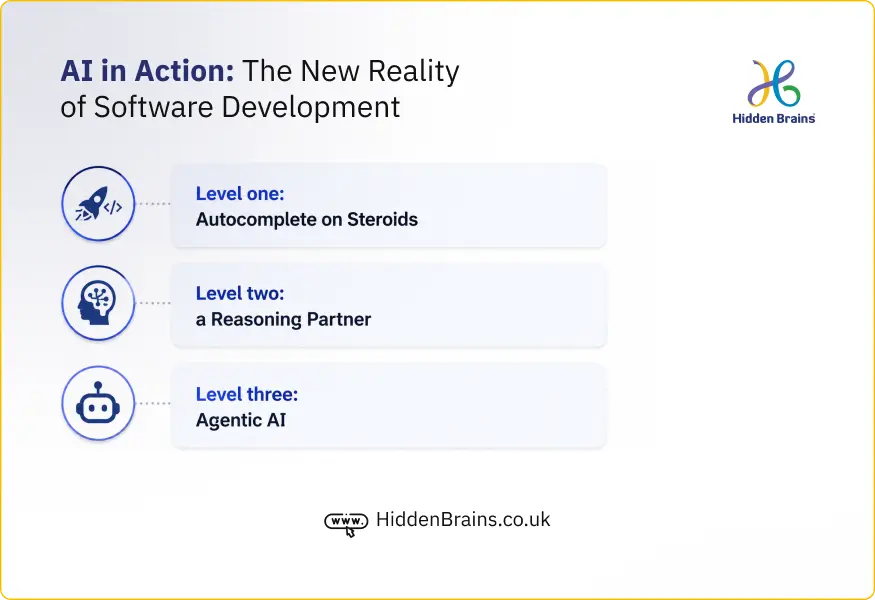
Level one: autocomplete on steroids
This is the GitHub Copilot layer, AI that suggests the next line, function or test as you type. It’s useful, it’s low-risk, and it’s where 84% of developers now sit, according to the Stack Overflow 2025 Developer Survey. Fifty-one per cent of professional developers use an AI tool daily.
Level two: a reasoning partner
Here AI reviews pull requests, drafts test suites against your actual codebase, flags security issues before a human ever looks, and explains legacy code nobody on the current team wrote. This is where the productivity numbers get interesting. A controlled study by GitHub and Microsoft, involving several developers, found teams completed coding tasks 55.8% faster with AI assistance and were 78% more likely to finish the task successfully at all.
Level three: agentic AI
This is the newest and least mature layer of systems that plan and execute multi-step development tasks with minimal supervision: raising a ticket, writing the fix, running the tests, opening the pull request.
Gartner expects 40% of enterprise applications to include task-specific AI agents by the end of 2026, up from under 5% in 2025. Most UK businesses aren’t ready for this level yet, and that’s fine. Trying to run agentic AI before your team trusts basic AI-assisted coding is like handing someone the keys to an automated production line before they’ve learned to read the safety manual.

The Benefits of AI in Software Development That Actually Move the Needle
Set aside the vague promises for a moment. Here’s what the data actually shows about the benefits of AI in software development, and why UK product and IT leaders are paying attention.
Faster delivery cycles
GitHub’s research with Accenture found pull request lead time dropped from 9.6 days to 2.4 days once AI tooling was embedded into the review workflow, a 75% reduction.
Real-time savings on routine work
Developers report saving up to 60% of the time they’d normally spend on coding, testing and documentation tasks, freeing them for architecture and product thinking.
More output without proportional headcount growth
This is the one that gets a product head’s attention in a budget meeting. Teams take on more scope without the six-month hiring cycle that used to come with it.
Fewer routine errors reaching production
AI-assisted code review catches structural and readability issues earlier; though this matters, it doesn’t remove the need for human sign-off. More on that below.
Most of the gains above only materialise when AI is designed into the workflow from day one, not bolted on afterwards. That’s the difference between AI as a novelty and AI as part of proper software development services.
It also matters more the bigger and older your system gets; legacy platforms with years of undocumented logic behind them are exactly where AI-assisted code analysis earns its keep, which is a big part of why enterprise software development solutions teams are among the fastest adopters right now.
How AI Transforms the Software Development Life Cycle (SDLC)
To see the true impact of AI in software development, let’s explore how it alters each traditional phase of product delivery:
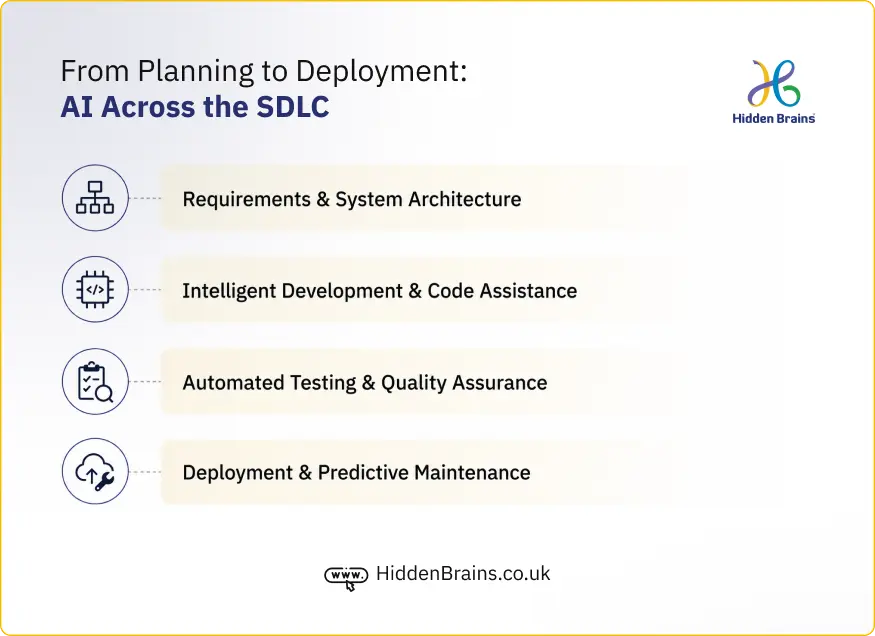
Requirements & System Architecture
Traditionally, translating business requirements into technical blueprints required lengthy discovery workshops and manual documentation. Today, AI models can analyze business requirement documents, identify ambiguous specifications, and generate initial data schemas or API workflows. This allows software architects to validate architectural choices before writing a single line of code.
Intelligent Development & Code Assistance
During the active coding phase, AI tools act as intelligent “pair programmers.” They suggest inline code completions, convert natural language comments into executable logic, and help developers quickly navigate unfamiliar frameworks. This slashes context-switching and keeps developers in a continuous “flow state.”
Automated Testing & Quality Assurance
Quality assurance (QA) is often a major delivery bottleneck. AI transforms the QA and testing process by dynamically reading feature specifications and automatically writing comprehensive unit, integration, and end-to-end test cases. Rather than waiting for manual testers to discover software flaws post-build, AI-driven testing runs continuously within your DevOps pipeline.
Deployment & Predictive Maintenance
Once software is live, AI observability agents monitor system logs, cloud telemetry, and user traffic in real time. Instead of reacting after a server crash or outage occurs, predictive AI models flag anomalies early, allowing your post-launch support team to resolve issues proactively before your customers ever notice.
Must Read: How Much Does Custom Software Development Cost in the UK
Where UK Businesses Are Getting AI Software Development Wrong
Here’s the uncomfortable part. Whilst 85 to 91% of UK organisations are increasing their AI investment year on year, only 31% report a positive return on it. Helium42’s 2026 AI Adoption Benchmark Report puts the cost of that gap between intention and execution at roughly £78 billion in unrealised value across UK businesses in 2025 alone. That’s not a technology problem. It’s an execution problem, and it shows up in three consistent ways.
Mistake one: treating AI as a bolt-on, not a workflow change
Buying licences for an AI coding assistant and expecting transformation is like buying gym equipment and expecting fitness. The tool has to change how work actually moves through the team: code review standards, testing gates, definition of done, or it just sits there generating suggestions nobody integrates properly.
Mistake two: no governance, no accountability
Only 7% of UK organisations are pursuing an enterprise-wide AI strategy with defined governance, per the same Helium42 research. Meanwhile, trust in AI output sits between 29% and 46% among developers themselves, which tells you something important: even the people generating the code don’t fully trust it unchecked. Without a clear owner for AI governance, that scepticism either blocks adoption entirely or, worse, gets ignored and lets flawed code slip through.
Mistake three: nobody’s closing the skills gap
Over 60% of UK businesses cite the skills gap as their primary barrier to effective AI adoption. You can’t buy your way past this one. Teams need structured training on prompting, reviewing AI output critically, and knowing exactly where the line sits between “AI drafted this” and “a human is accountable for this.”
What This Looks Like in Practice
Picture a mid-sized UK financial services firm running a claims-processing platform that’s been patched and extended for over a decade. Nobody left on the team wrote the original code. Every change request starts with someone spending half a day just working out what a module does before they can safely touch it.
Bring AI-assisted code analysis into that picture and the equation shifts. The AI doesn’t rewrite the platform overnight nobody sane would trust that but it can map dependencies, flag where a proposed change might break something three modules away, and draft an initial test suite against the existing behaviour before a developer commits to a single line.
The developer still makes the call. They make it with better information, in less time. That’s the pattern worth copying: AI doing the reconnaissance, humans making the decisions that carry real consequences. Not the other way round.
Building a Roadmap for AI Software Development in Your Business
You don’t need an enterprise-wide AI strategy document before you start. You need a contained first move that tells you something real.
• Audit what you’ve already got: most UK businesses are surprised to find developers already using AI tools informally, with no policy governing how. Start there before buying anything new.
• Name someone accountable for AI governance: code review standards, data handling rules, and a clear line on what AI can touch unsupervised. This shouldn’t be an afterthought owned by nobody.
• Pick one contained pilot: a single team, a single project, a fixed review period. Not “roll it out everywhere and see.”
• Train people properly: reviewing AI output critically is a skill, not a given. Budget time for it, not just licence fees.
• Measure outcomes, not activity: lead time, defect rates and review speed tell you far more than “how many developers logged into the tool.”
If that list feels like more than your internal team has capacity for right now, that’s a normal place to be; it’s exactly why so many UK businesses bring in business technology consulting support to run the audit and set the governance framework, rather than guessing.
And if the pilot you land on involves customer-facing systems, pairing that governance work with proper web application development solutions from the outset avoids the classic mistake of retrofitting security and testing standards after the AI-assisted build is already in production.
Where This Leaves You
The role of AI in software development isn’t a future question anymore; it’s a current one, and the businesses treating it that way are already 55% faster through their review pipelines while the rest are still drafting a policy document. You don’t need to adopt everything at once, and you shouldn’t.
But you do need a governed pilot, a named owner, and a way to measure whether it’s actually working, not just whether it’s switched on. Get that foundation right, and scaling from a single team to genuine enterprise-wide capability becomes a controlled next step rather than a leap of faith. The UK businesses winning this decade won’t be the ones that adopted AI first. They’ll be the ones that adopted it properly.
How Hidden Brains Can Help
You’ve read the roadmap. Somebody still has to walk it.
That’s usually where good intentions stall, not because the plan is wrong, but because nobody has three days a week free to run an AI audit while also shipping the current sprint.
Hidden Brains UK has spent 23+ years building and modernising software for businesses long enough to have delivered over 6000 solutions across 39+ industries, for a client base of 2,400+ and counting. The AI questions we get now are rarely “should we use it?” They’re “where do we start without breaking what already works?” and that’s a question easier to answer with a 500-strong team that’s already seen most of the ways a legacy system can go wrong.

Conclusion
The role of AI in software development will keep shifting, but the businesses that benefit are the ones building capability now, not waiting for a perfect moment that won’t arrive. Start small, govern properly, measure what matters, and bring in support where your internal team is stretched thin.
Hidden Brains UK has spent over two decades turning ambitious UK businesses into technically confident ones, and AI is simply the next chapter in that work. If you’re ready to move from reading about this to actually building with it, we’re ready to talk.
Frequently Asked Questions
What is the role of AI in software development for UK businesses?
The role of AI in software development is to speed up coding, testing and documentation while improving decision-making across the delivery lifecycle. UK businesses use it for code generation, automated testing, code review, and increasingly for agentic tasks that run with limited human input, cutting delivery time without cutting corners.
How is AI in software development changing the way apps are built?
AI in software development is shifting teams from writing every line manually to reviewing, directing, and refining AI-generated output. Developers now spend more time on architecture, security and business logic, while routine coding, test scaffolding and documentation are increasingly machine-assisted.
What are the main benefits of AI in software development?
The main benefits of AI in software development are faster delivery cycles, reduced time spent on routine coding and testing, and more consistent documentation. Teams also gain capacity to take on more enterprise software work without proportionally growing headcount.
Is AI software development safe for regulated UK industries like finance and healthcare?
AI software development can be safe for regulated UK sectors when it’s paired with human code review, audit trails and clear governance over what AI tools can and cannot touch. The risk isn’t the technology itself, it’s deploying it without oversight, testing standards or accountability.
How much does it cost to add AI in software development to an existing UK business?
Costs vary widely: a contained pilot using existing AI coding assistants can start from a few thousand pounds in licensing and training, while a full governance framework and workflow redesign for a larger enterprise typically runs into tens of thousands. Most UK businesses see the clearest return by starting small and scaling what works.
Will AI replace software developers in the UK?
No credible evidence points to AI replacing UK software developers wholesale. Current data shows AI reshaping the job, automating routine tasks while increasing demand for developers who can direct, review and secure AI-generated code, not eliminating the need for skilled engineers.
Table of Contents